Korea's Jindo Dog: The One-Person Dog, and What's True About the Famous Stories
A Natural Monument since 1962, a dog that came home across the country in 1993, and a law that keeps registered Jindos on their island. Here's what is documented, what is legend, and where to see them.
The Short Version
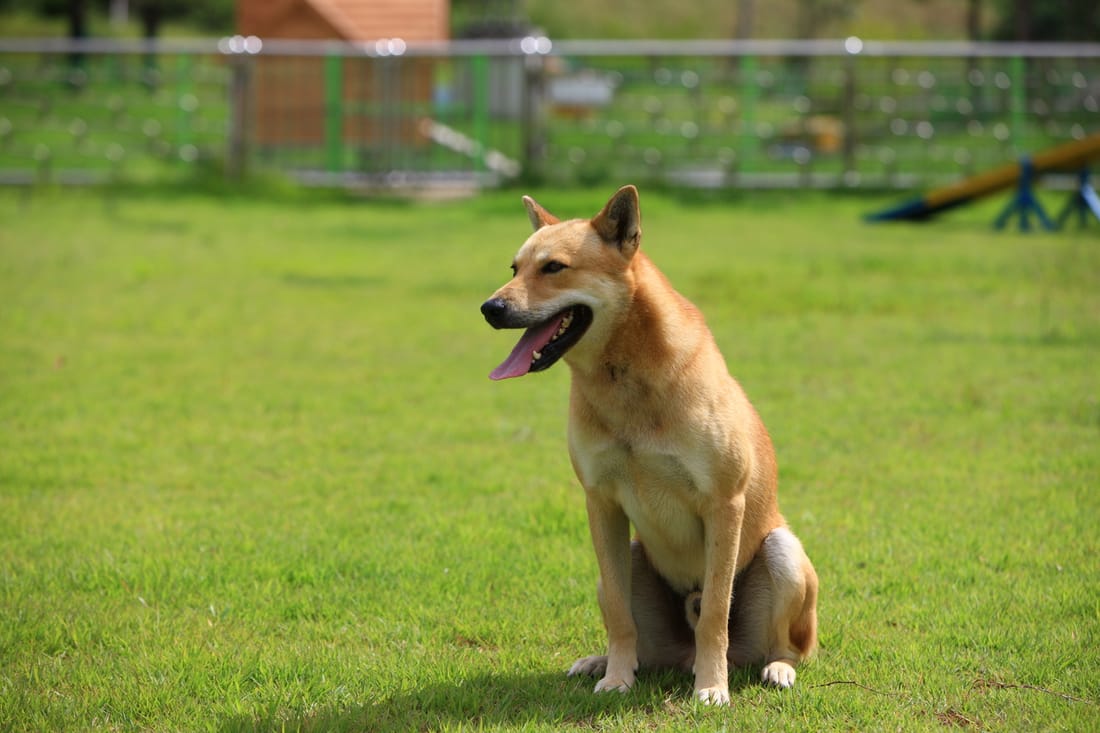
The Jindo is Korea's best-known native dog: upright ears, a tail that curls over its back, and a reputation for choosing one person and staying chosen. This guide goes with Mori's latest video. We checked the video's stories against Korean sources on October 1, 2026, and two of them are told a little differently here.
- Korea designated the Jindo dog Natural Monument No. 53 on December 3, 1962 (Jindo County). The numbering system itself was dropped in 2021, so today it is simply a Natural Monument.
- The international breed standard (FCI No. 334) lists six coat colors. In Korea, white and tan are by far the most common.
- The 1993 homecoming of a white Jindo from Daejeon to Jindo is a real event with a statue to mark it. The route she took is something nobody saw.
- The dog that stayed beside a missing woman for about 40 hours in 2021 was real too. Korean reports describe a white former stray and do not name a breed.
- Under Korean law, registered Jindos cannot be taken out of Jindo County without the county governor's permission.
What a Jindo Is
A medium-sized hunting dog from one island county, protected by its own law.
An Island Dog With a Heritage Title
Jindo is an island county at the southwest tip of the Korean peninsula. Jindo County's own history page says the dog was first given protected status on May 3, 1938, under Japanese colonial rule, and was designated Natural Monument No. 53 by the Korean government on December 3, 1962. A separate law, the Korean Jindo Dog Protection and Promotion Act, followed in 1967.
The Encyclopedia of Korean Culture describes it as a medium-sized hunting dog. The FCI standard puts males at 50–55 cm at the shoulder and females at 45–50 cm, with thick triangular ears that stand fully upright and a tail that is rolled or sickle-shaped, its tip touching the back or flank.
Named by Color
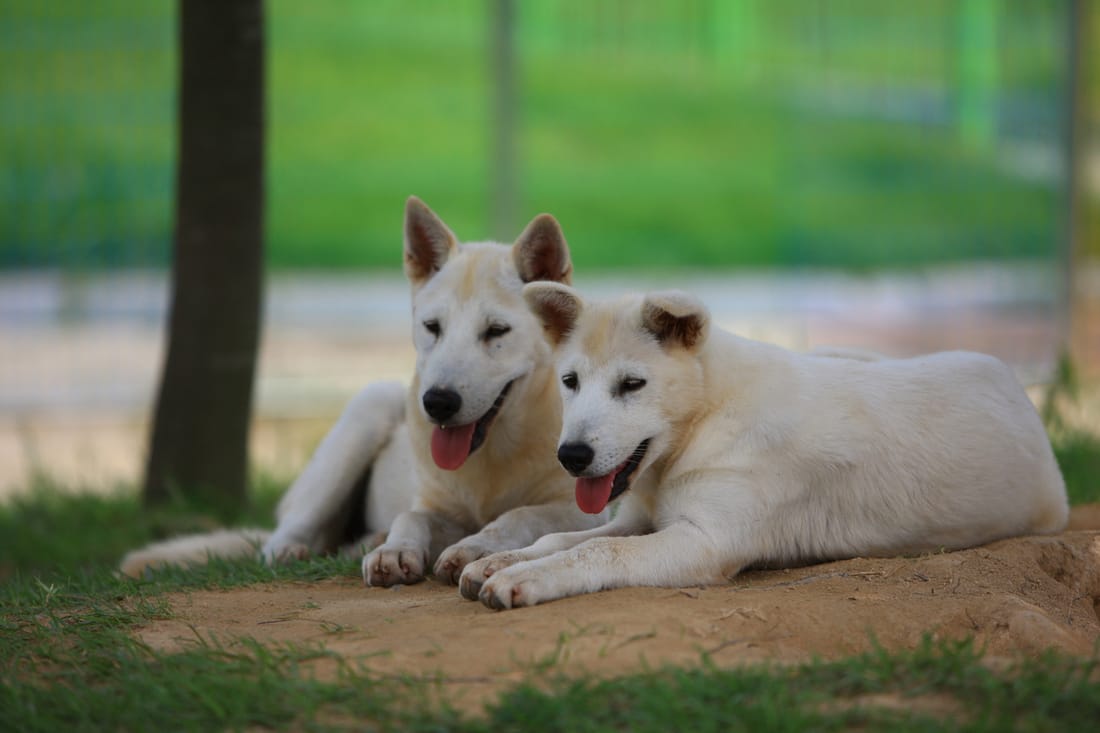
Koreans name these dogs by coat. A 2018 press release from Korea's National Institute of Animal Science lists six types:
- Baekgu (백구): white
- Hwanggu (황구): tan, the "red fawn" of the FCI standard
- Heukgu (흑구): black
- Jaegu (재구): grey
- Hogu (호구): brindle, striped like a tiger
- Nenunbagi (네눈박이): black and tan
The FCI standard accepts all six. The same press release notes that Korea's own standard at the time recognized only tan and white, which is why those two are what you mostly see.
The One-Person Reputation
What the Breed Standard Actually Says
The loyalty is not just folklore. The FCI standard describes the Jindo as extremely faithful to its master. It adds that a Jindo will accept a new owner but does not forget the one who raised it from a puppy. Jindo County's own list of the dog's traits starts with loyalty and a homing instinct, then boldness, cleanliness, hunting instinct, wariness of strangers, and not being easily lured away.
The same standard is frank about the other side: a very strong hunting instinct, and a dog that is, in its words, not fond of other animals, especially males.
Two Famous Stories, Checked
Both happened. Each is usually told with a detail or two that the record does not support.
1The Dog Who Came Home (1993)
- What is recorded: in March 1993 a white Jindo from Donji village in Uisin-myeon, Jindo, was sold to a buyer in Daejeon. In October, seven months later, she turned up at her old home. Yonhap reported the story again in 2004, when Jindo County unveiled a statue of her in the village on November 27.
- What is not recorded: the journey. Korean accounts give the distance as more than 300 km (about 186 miles), which is roughly how far Daejeon is from Jindo. Nobody followed her, so the route she actually took, and how far she walked, are unknown.
- The statue still stands in Donji village. Koreans know the story as "Doraon Baekgu" (돌아온 백구), the white dog who came back, and it has been retold in children's books and animation.
Sources: Yonhap, November 25, 2004; Digital Jindo Culture Encyclopedia (Academy of Korean Studies). Her birth and death years differ between sources, so we leave them out.
2Forty Hours in a Rice Paddy (2021)
- In late August 2021 a woman in her 90s with dementia went missing from her home in Hongseong County, South Chungcheong Province. Her family reported it on the morning of August 25.
- She was found at about 3:30 p.m. on August 26, roughly 40 hours later, collapsed at the edge of a flooded rice paddy after heavy rain. The family's white dog was pressed against her.
- Kyunghyang reported that a police thermal drone could not pick her up because her body temperature had dropped, and that it was the dog's body heat the drone detected. She was treated for hypothermia and recovered.
- On September 6, 2021, the governor of South Chungcheong appointed the dog Korea's first honorary 119 rescue dog, at Hongseong Fire Station.
Two corrections to how this story is usually told, including in our own video. First, the Korean reports we read call the dog Baekgu, "white dog", and describe a former stray the family had taken in three years earlier. None of them names a breed, so we can't call this a Jindo story. Second, reports give the woman's age as 90 or as 93. We have left out her name.
Sources: Kyunghyang Shinmun and Financial News, September 6, 2021; Seoul Shinmun, September 7, 2021.
Harder Than They Look
Hunter, Neat Freak, Free Thinker
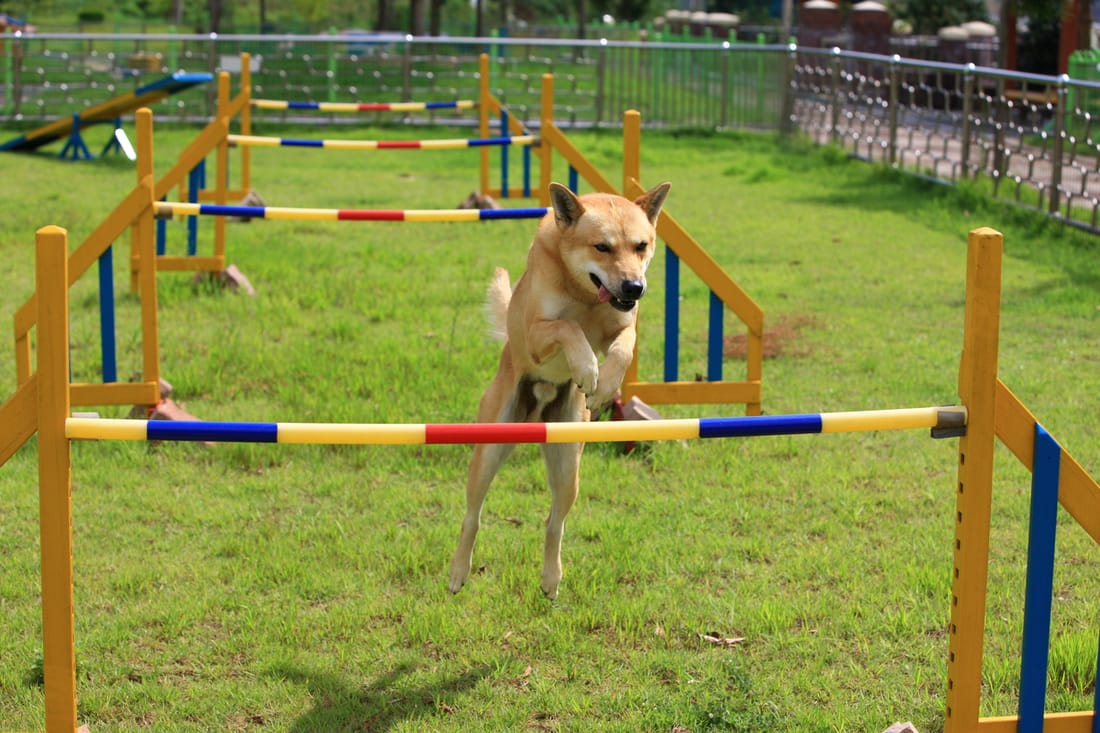
- Hunting: the FCI standard gives the Jindo's use as a hunting dog. You will often read that Jindos hunted wild boar, and the video repeats it as "some accounts say". The official descriptions we could check are more modest: the Encyclopedia of Korean Culture says small and medium-sized game, and the Digital Jindo Culture Encyclopedia names deer and rabbits.
- Clean: Jindo County lists cleanliness among the breed's traits, and the Encyclopedia of Korean Culture describes careful grooming and covering its waste with soil. The coat is a double coat, a soft dense undercoat under a stiff outer one, so it still sheds.
- Independent: the same hunting background that makes a Jindo bold also makes it a dog that decides things for itself. Expect a dog that understands you perfectly well and then weighs it up.
Seeing Jindos in Jindo
If you are travelling in Korea's southwest, the island has a county-run park built around its dog.
1Jindo Dog Theme Park (진도개테마파크)

- Where: Seongjukgol-gil, Jindo-eup, Jindo County, South Jeolla Province. Phone 061-540-6308. Jindo is an island, joined to the mainland by Jindo Bridge.
- What it is: the county's former Jindo dog research center, opened in 1999 and expanded into a theme park in 2014. The Digital Jindo Culture Encyclopedia lists a Jindo dog promotion hall, a dog play yard, a small animal farm, a sledding slope and an arena for dog sports.
- Cost: the same source says admission is free, including the shows.
- Shows: according to a January 2026 report of the county's announcement, the park opened for the season on January 31 and runs through December, with dog sports at 10:00 and 15:00 on weekdays and a performance at 11:00 on weekends and public holidays.
The county's tourism page for the park does not list opening hours or closing days, and older listings give different weekend show times. Call before you make the trip.
2The Baekgu Statue in Donji Village
- The statue of the dog who came home stands in Donji village, Uisin-myeon, on the island. It is a village square with a statue and a marker engraved with her journey, not a staffed attraction.
- This is a farming village where people live. Keep it short and quiet.
Can You Take One Home?
Registered Jindos Stay in Jindo
The Korean Jindo Dog Protection and Promotion Act makes the whole of Jindo County a protection zone. Article 11 says nobody may take a Jindo dog out of the zone. The exceptions need the county governor's permission, and the law lists four: a supply plan approved by the Korea Heritage Service, registered dogs that can no longer breed or are too old to be worth protecting as Natural Monuments, puppies of dogs that were ordered out of the zone, and temporary trips to dog shows and promotional events. The same article restricts bringing other dogs in.
That rule covers registered dogs in Jindo County. Jindo-type dogs are bred and kept all over Korea, and Jindo County publishes a list of dog breeding and sales businesses on its website while stating that it is not affiliated with them.
If You Are Thinking of Living With One
- Other pets: the breed standard itself says Jindos are not fond of other animals. A home with cats or a second dog needs honest thought.
- One person: a dog that bonds this hard to one human can be slow with everyone else in the house, and with visitors.
- Rehoming: the standard says a Jindo accepts a new owner but never forgets the first. That is the charm in the Baekgu story and the difficulty in real life.
- Coat and energy: a double coat sheds, and a hunting dog needs daily exercise and a secure space.
⚠ This is general information, not veterinary, training or legal advice. Individual dogs differ from any breed description. Rules on moving dogs out of Jindo County and across borders are set by Korean law and by your own country's import rules, so check with Jindo County and the relevant authorities before acting. Park hours and show times are as reported in 2026 and can change.
 Mori: Here it's the Jindo, and the white dogs I met growing up always seemed to be called Baekgu. I only learned while making this that it literally means "white dog". What's the famous one where you live?
Comments open soon.
Video credits
Music and sound effects: Han River Chill by u_98673jp944 (Pixabay Content License)
Photos used in the videos: Herocosmos / Wikimedia Commons (CC BY-SA 4.0) · Mitch Barrie / Wikimedia Commons (CC BY-SA 2.0) · Mitch Barrie / Wikimedia Commons (CC BY-SA 2.0) · Mitch Barrie / Wikimedia Commons (CC BY-SA 2.0) · Doo ho Kim / Wikimedia Commons (CC BY-SA 2.0) · Canarian / Wikimedia Commons (CC BY-SA 4.0) · Canarian / Wikimedia Commons (CC BY-SA 4.0) · bein_korean / Wikimedia Commons (CC BY 2.0) · Mitch Barrie / Wikimedia Commons (CC BY-SA 2.0) · Mitch Barrie / Wikimedia Commons (CC BY-SA 2.0) · Canarian / Wikimedia Commons (CC BY-SA 4.0) · Daniele Napolitano / Wikimedia Commons (CC BY-SA 4.0) · Jangg8962 / Wikimedia Commons (CC BY-SA 4.0) · Wolf Park / Wikimedia Commons (CC BY-SA 4.0) · Jojeda1981 / Wikimedia Commons (Public Domain) · Nicki Dugan Pogue / Flickr (CC BY-SA 2.0) · Wikimedia Commons contributor (own dedication) / Wikimedia Commons (CC0) · Korea Tourism Organization PhotoKorea (KOGL Type 1) · 진도군청 Jindo County Office (KOGL Type 1 (공공누리 제1유형)) · OpenStreetMap contributors (ODbL)
Full source and license details are on the Credits page.