Budae-jjigae: Korea's Army-Base Stew, and the President One Version Is Said to Be Named After
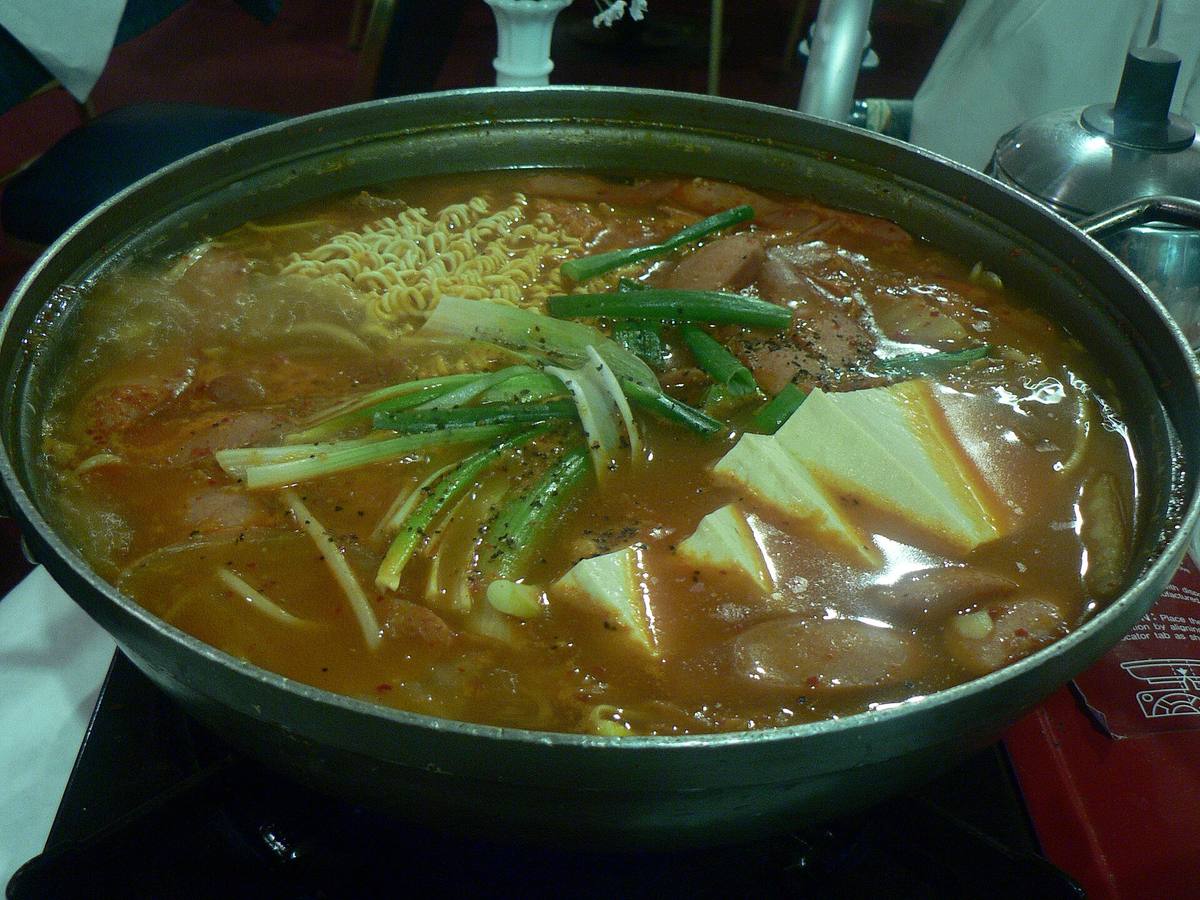
Budae-jjigae started as a way to stretch whatever US Army base surplus and leftovers Koreans could buy, trade for, or scavenge in the desperate years right after the Korean War — Spam, sausage, baked beans, boiled into one pot with kimchi and gochujang because there was little else on hand. One Seoul variant, Johnson-tang, is said to be named after Lyndon B. Johnson's real 1966 visit to Korea — but the story that he ever tasted it is unverified, a Korea Heritage Service magazine feature calls the name storytelling, and sources disagree on when the restaurant behind it opened.
A War Emptied the Country's Pantries, and Army Bases Filled Part of the Gap
The Korean War ended in 1953 with the country's food supply in ruins. What people living near US military bases did next — turning discarded and surplus American rations into something edible, then eventually into something worth naming — is the actual origin of one of Korea's most recognizable stews today.
Kkulkkuli-juk: the food that came before budae-jjigae had a name
In the years right after the armistice, people in towns built up around US bases scavenged or bought whatever came out of the base kitchens — scraps, half-eaten leftovers, whatever wasn't thrown out — and boiled it into a rough stew people called kkulkkuli-juk (꿀꿀이죽), something close to "pig-slop porridge." The name wasn't affectionate. It described exactly what the dish was: base leftovers, reboiled into something a hungry person could eat. Budae-jjigae, in its more recognizable form, grew directly out of this practice once people started working with base surplus on purpose, as an ingredient, rather than out of pure desperation.
A street stall in Uijeongbu, and a dish built one customer request at a time
Uijeongbu — a Gyeonggi-do city just north of Seoul, ringed by US Army installations — holds the most widely cited origin claim, built around one specific person: Heo Gi-sook, who sold odeng (fish cake skewers) from a street stall there starting around 1960, according to her 2014 obituaries and a 2013 court order (a Korea Heritage Service magazine feature says 1963). As those obituaries tell it, civilian workers at nearby US bases brought her ham, sausage, and bacon, which she first stir-fried and sold; when regulars asked for something to eat with rice, she turned the stir-fry into a stew with kimchi and gochujang. She received a business permit for the restaurant under the name Odeng Sikdang (오뎅식당) on May 11, 1968, per the court record. Her obituaries in Seoul Shinmun and Herald Business added that no exact record exists of when, where, or how budae-jjigae began — Uijeongbu simply recognizes her as the originator.
In January 2013, the Uijeongbu District Court granted a provisional injunction (case 2012카합408) to the company then running Odeng Sikdang, barring a rival restaurant about 70 meters away from using the "Odeng Sikdang" name on its signs, packaging, and advertising. The court reasoned that the name had become widely known in and around Uijeongbu as Odeng Sikdang's, and that the rival had registered a service mark to cause confusion — an abuse of trademark law. Korean media reported the ruling on February 3, 2013 as a fight over the "original" name. The order itself is about the right to use the name; it does not declare who invented budae-jjigae. A 2018 feature in the Korea Heritage Service's monthly magazine, by journalist Lee Chun-ho, nonetheless says the court ruled that Odeng Sikdang is the origin of Uijeongbu's budae-jjigae — which goes further than the order's own wording. Separately, in November 2021, Korea's Patent Court ruled that a 2012 service-mark registration for "Odeng Sikdang," covering budae-jjigae delivery and related services, was invalid because consumers could be misled into expecting fish cake in the stew (reported by WIPNEWS and Etoday in February 2022).
The Name Just Means "Military Unit Stew" — and Uijeongbu Wasn't the Only Base Town Making It
Korea didn't dress the name up at all. "Budae" is a plain Korean word for a military unit, and the dish is named after exactly where its ingredients came from — which also means no single town gets to claim it outright.
Budae (부대): not a brand, just the word for "troops"
Budae (부대, 部隊) is ordinary Korean for a military unit, corps, or garrison — it carries no special culinary meaning on its own. Jjigae (찌개) simply means "stew." Put together, budae-jjigae translates as bluntly as "army-unit stew" or "army-base stew": there's no attempt to disguise where the dish's identity comes from, unlike a lot of foods that pick up prettier names once they move upmarket.
Uijeongbu has the best-known origin claim, but it was never the only base town cooking this
Even English Wikipedia's own entry on the dish hedges on a single origin point, noting plainly that "it is not known with certainty where the dish first arose" and that multiple restaurants and cities claim the title. Budae-jjigae developed its own local identity around several other base towns at the same time:
- Dongducheon and Yangju (Gyeonggi-do) — built around their own long-standing US Army installations, with restaurant clusters that developed independently of Uijeongbu's.
- Songtan, in Pyeongtaek — grew up around what's now Osan Air Base, with its own regional style and following.
- Munsan, in Paju — another Gyeonggi-do base town near the DMZ with its own long-running budae-jjigae restaurants.
- Yongsan, in Seoul — home to the variant covered below, distinct enough to carry its own separate name rather than just calling itself budae-jjigae.
Uijeongbu's own Budae-jjigae Street (부대찌개 거리) — the restaurant cluster most visitors encounter today — had coalesced into a defined food district by around the late 1990s. It was never the only town cooking this, just the one that ended up with both a court case over a restaurant name and the tourist street.
One Version Is Said to Carry a US President's Name
Not every regional variant stayed anonymous. In Seoul, one version of the dish ended up called Johnson-tang — usually explained as a reference to Lyndon B. Johnson, the 36th US president, though what actually connects him to a bowl of stew depends heavily on which source is telling the story.
Johnson-tang: same base ingredients, a different bowl entirely
Johnson-tang (존슨탕) developed around Yongsan, the Seoul district that has hosted a US military garrison for decades, tied most specifically to a restaurant called Bada Sikdang (바다식당) in nearby Itaewon. A Korea Heritage Service magazine feature dates the restaurant to 1970 and names its owner as Park Jeom-sun; the National Encyclopedia of Korean Culture instead says it opened in the late 1970s. It isn't just a rebranded budae-jjigae — the recipe itself differs: plain cabbage stands in for kimchi, ramyeon noodles are left out entirely, and cheese is a default ingredient rather than an optional add-in. Where most budae-jjigae is simmered at the table in front of the diner, Johnson-tang traditionally arrives already cooked.
The Johnson connection: a real presidential visit, and a much shakier story about a bowl of stew
President Lyndon B. Johnson did visit Seoul — that part is entirely real and well documented. He landed on October 31, 1966, on the last leg of a seven-nation trip, greeted by crowds estimated at up to two million lining a nine-mile motorcade route, there mainly to thank South Korea for its troop commitment to the Vietnam War. What's far shakier is the specific claim that he personally tasted and loved the stew that now carries his name. A 2018 feature by journalist Lee Chun-ho in the Korea Heritage Service's monthly magazine states that Johnson tasted budae-jjigae on that visit and that, four years later, the dish was named Johnson-tang after his surname in order to "storytell" it (스토리텔링) — but the feature cites no source for the tasting.
Korean-language Wikipedia and Namuwiki both go further, listing the presidential-visit story as just one of several competing folk explanations for the name — including a theory that "Johnson" was simply a common American name used as a generic label (Namuwiki compares it to a Korean dish called "Cheolsu-tang," after a common Korean name) — and hedge every version with language equivalent to "the story goes," not settled fact. Other sources, including English-language ones and the National Encyclopedia of Korean Culture, state the presidential version more matter-of-factly. Given how differently these sources treat it, this article treats the Johnson connection as an unverified legend, not history.
From Wartime Scrap Food to a Name Worth Fighting Over in Court
There's something worth sitting with in the fact that a dish invented from discarded and surplus military-base food now has cities competing for origin bragging rights, a real court case over who may use the name "Odeng Sikdang," and a whole tourist street built around it. Budae-jjigae never got quietly renamed or distanced from its own origin — Korea kept the name that plainly says "this came from an army base," kept the Spam and the instant noodles, and turned the whole story into something worth visiting Uijeongbu for. Whatever actually happened between Lyndon Johnson and a bowl of stew in 1966, the dish didn't need a president's name to become one of Korea's most recognized comfort foods either way.
Comments open soon.