Dak-Hanmari: The Everyday Chicken Pot That Turned a Dongdaemun Alley Into a Tourist Pilgrimage
A no-frills chicken-and-noodle pot born in Dongdaemun's 1970s market alleys is now a must-stop for Japanese visitors to Seoul — with viral knife-work videos, a national instant-noodle tie-in, and prices climbing to prove it.
The Line That Wasn't There a Few Years Ago
The dish hasn't changed. The crowd standing in front of it has.
A side alley off Dongdaemun Market
Tucked inside Sinjin Market, on the alley between Jongno 5-ga and Dongdaemun stations, roughly nine restaurants sell close to nothing but dak-hanmari — a whole chicken simmered in broth, built to be shared across a table rather than eaten alone. It's one of the least glamorous dishes in Korean cooking: a market lunch for merchants and factory workers, not a special-occasion order. Lately, that hasn't mattered. Lunch and dinner now routinely bring lines down the block, and by several accounts, most of the people in them aren't Korean.
- Sinjin Market alley (Jongno 40-gil), a short walk from Dongdaemun Station (Line 4) Exits 8–9
- Around nine dak-hanmari restaurants line the alley — that is the count in a 2017 Seoul city-portal article, so the number may have shifted — from newcomers to Jin Ok-hwa Halmae, which opened in 1978
- Foreign visitors reportedly make up over half of diners, and 70–80% on weekends and at peak times (shop-reported estimate, Wikitree, July 2026)
- Recent press reports put a pot for two at 30,000 won or more — up from roughly 20,000 won just a few years ago (see below). Prices differ by restaurant and change, so check the menu
What's Actually in the Pot
It looks like it could just be boiled chicken. The second act is the whole point.
One bird, two stages
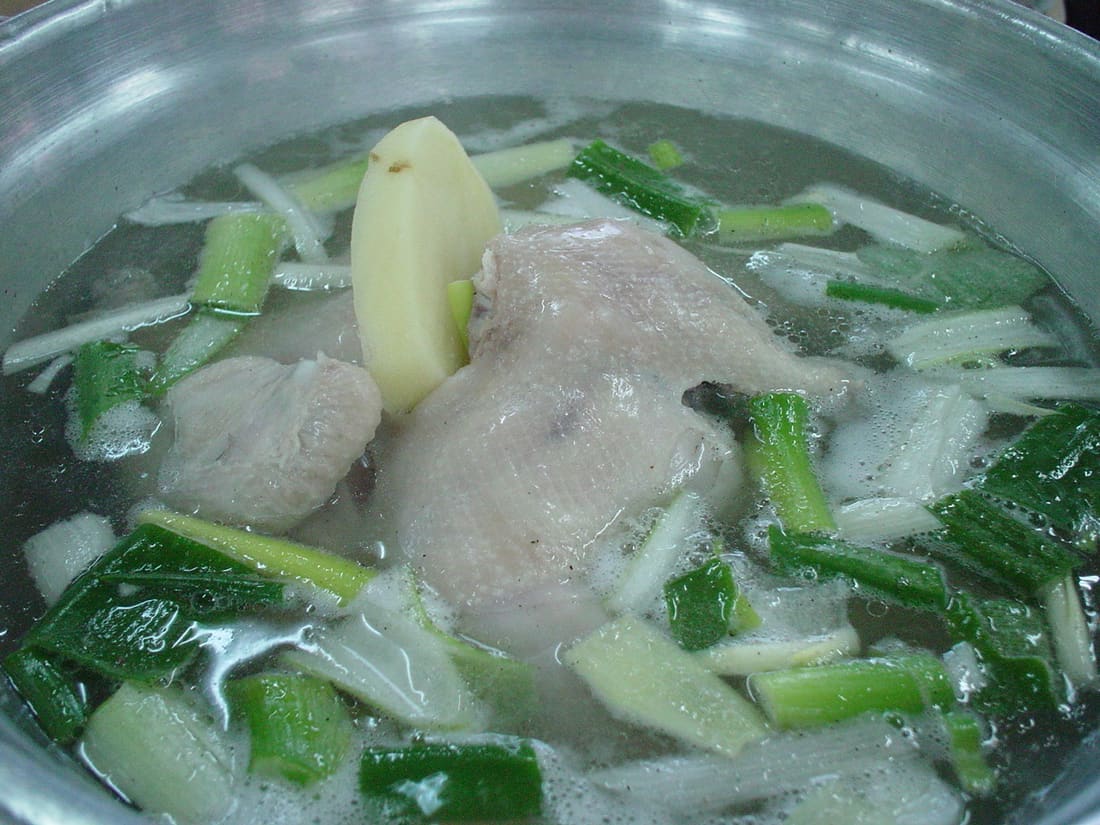
A young whole chicken — usually graded "8-ho" to "9-ho," a Korean poultry sizing scale that puts the bird somewhere in the 750–950 g range — goes into a wide shared pot with potato, scallion, and whole garlic cloves, simmered in a plain broth. It arrives at the table looking close to baeksuk, Korea's plain boiled-chicken soup, and for the first stage, it's eaten the same way: pull the meat apart and dip it, piece by piece, in a sauce built from soy sauce, vinegar, mustard, and a spoon of hot pepper. What separates dak-hanmari from baeksuk happens after the chicken is mostly gone — kalguksu, hand-cut wheat noodles, go into the leftover broth and cook right there in the pot, sometimes alongside sliced rice cake. The two-stage structure isn't optional or a side dish tacked on; it's the reason the dish has its own name instead of just being a variation on baeksuk.
It's also a different animal from samgyetang, Korea's other famous whole-chicken dish — samgyetang is a single-serving bowl stuffed with ginseng and rice, no noodle course involved. Dak-hanmari is built for a table of two or three, and the noodles are the point, not an afterthought.
Why the Order Started With Impatient Customers
Neither of the two name origin stories restaurant owners tell is a tale about invention. Both are about a market with no time to spare.
Two stories, both about being in a hurry
Restaurant owners on the alley pass down two competing explanations for the name — and neither has been settled as the definitive one. The first: this used to be an area with heavy bus-terminal and market foot traffic, and rushed customers would order by shouting "dak hanmari, ppalli!" — "one whole chicken, quick!" — which stuck as the dish's name. The second: it means eating an entire bird "completely," nothing wasted — the meat first, then the broth turned into a noodle course rather than thrown out. Both stories point at the same thing from different angles: a dish built around efficiency, not ceremony.
From market noodle stalls to a 1978 restaurant that's still open
Seoul city's own materials trace the alley to chicken-kalguksu vendors serving Dongdaemun and Pyeonghwa market merchants, factory workers, and office employees on tight lunch budgets — the noodles were the original draw, with the whole-chicken format developing around them. A 2017 article carried on the city's information portal dates the dish's fame to 1978, and a 2022 column in the city's own magazine puts the beginnings in the 1970s. The boom years were the 1980s and '90s, as word spread to nearby company workers and the alley grew to fill with competing stalls. One of that generation's restaurants, Jin Ok-hwa Halmae Wonjo Dak-hanmari, is listed by the Korea Tourism Organization as opened in 1978 and still running today — a single-item menu, built entirely around chickens about 35 days old. It's often the name visitors are pointed toward first, though it's one of roughly nine on the alley, not the only one with a real history behind it; several restaurants there use the word wonjo ("original") in their names, so the label alone doesn't tell you which came first.
The Japan Connection
The format feels instantly familiar to Japanese diners. What they're reacting to is everything the format doesn't share with home.
A hot pot that already makes sense to them
Japan has its own close relative: mizutaki, a Fukuoka-region chicken hot pot that follows nearly the same order — clear broth first, then additions, then a starchy finish. That structural overlap is very likely part of why dak-hanmari reads as approachable rather than foreign to Japanese visitors. But the two dishes split hard on specifics. At Suigetsu, a Fukuoka mizutaki institution dating to 1905, a Korean trade-press writer reported this spring, the chicken is a 120-day-old rooster — chewier and more intensely flavored than the roughly 30-day-old chick used in Korea — and staff run the meal at the table as a per-person, multi-course menu. Dak-hanmari uses a young chicken, costs a fraction as much, and is largely DIY — the table dips, seasons, and times its own noodle course.
Scissors, screens, and a genuine surprise
Korean coverage points to the spectacle as part of the draw: watching staff drop a whole chicken into a shared pot — and, at some tables, quarter it in seconds with a pair of large kitchen scissors. That exact moment is what keeps circulating: short clips of the cut have picked up millions of views on Japanese social media, and Korean coverage has tracked visits from Japanese celebrities and influencers, including manga creator Takehiko Inoue, who visited in 2011, being shared and recirculated. On top of the food itself, visitors have specifically cited the alley's unrenovated, decades-old storefronts as part of the appeal — the opposite of a polished domestic chain, and treated as sightseeing in its own right rather than just a place to sit down and eat.
50%+
Share of the alley's diners reported to be foreign visitors, per shops in the alley as reported by Wikitree in July 2026.
70–80%
Reported foreign-visitor share on weekends and at peak times — the same shop-reported estimate.
1978
The year Jin Ok-hwa Halmae, one of the alley's oldest restaurants, opened, according to the Korea Tourism Organization. It's still serving today.
The Proof This Isn't Just a Tourist-Blog Story
The clearest sign a food trend has gone mainstream in Korea isn't a viral video — it's a packaged-food company betting money on it.
Ottogi bet on the alley's name, not just the dish
In July 2026, in the run-up to Chobok — the first of Korea's three midsummer "boknal" stamina-food days, when hot chicken soups are traditionally eaten — Ottogi, one of Korea's largest packaged-food makers, launched a retail instant kit called "Dongdaemun-style Dak-hanmari Kalguksu." The product and its marketing were built specifically around the alley's old-market identity, not "chicken soup" as a generic category — the pitch was the neighborhood's reputation, packaged. Launched July 13, it sold past 500,000 units in 18 days, according to the company, an unusually fast pace for the category, with word of mouth reportedly spreading among foreign visitors curious about K-food alongside domestic buyers.
The Price Tag Is Climbing, Too
Demand doesn't just show up as longer lines. It shows up on the bill.
From around 20,000 won to past 30,000
A pot that commonly cost around 20,000 won a few years ago now often runs past 30,000 won for two people, with some diners reporting prices as high as 33,000 won. Restaurant owners point to real added costs — the pot comes with two servings of kalguksu (about 10,000 won by one owner-side account) and vegetables, and tables that simmer and cook their own pot turn over more slowly than a fast-serve restaurant. Trade coverage of the area frames it more pointedly: with Dongdaemun now positioned as what local press calls a "dak-hanmari pilgrimage site" for visitors from Japan and China, it reads the price shift as tracking what tourist demand will support rather than what regulars are used to paying (the owners quoted above cite their costs instead) — and some domestic diners have pushed back publicly, confused about paying more for a shared pot than for a long-simmered baeksuk.
If You're Going
1Bring People, Not Just an Appetite
- This is a shared pot built for two or three, not a solo meal — most restaurants on the alley are set up around that assumption, down to the pot size.
2Timing Is the Real Variable
- The lines that make headlines form at lunch and dinner. A mid-afternoon visit, outside those windows, can be the difference between waiting and walking straight to a table. Jin Ok-hwa Halmae's Korea Tourism Organization listing gives hours of 10:30 a.m. to 1 a.m. daily, with last orders at 11:30 p.m.; hours at the other restaurants on the alley vary, so check before you go.
3Getting There
- About a five-minute walk from Dongdaemun Station (Line 4), Exits 8–9, inside the Sinjin Market alley between Jongno 5-ga and Dongdaemun stations. Roughly nine restaurants line the block — Jin Ok-hwa Halmae, opened in 1978, is often the first name visitors hear, but it isn't the only one with a long history there.
4Order Like a Regular
- Let the chicken and vegetables finish simmering first, and eat the meat dipped in the soy-vinegar-mustard sauce before asking for kalguksu. The noodles are meant to go in once the meat's mostly gone — calling for them too early skips the whole point of the second stage.
Comments open soon.