Japchae: The Noodle Dish That Didn't Have Noodles Until 1919
Japchae's name literally means 'mixed vegetables' — and for roughly three centuries, that's all the dish was. The glass noodles everyone pictures today didn't show up until a 1919 factory in what's now North Korea changed the recipe, and the popular origin story about the Joseon official who supposedly invented it skips over what Korea's own court records actually say about him. Here's what's genuinely documented, what's later polish, and the ingredient-by-ingredient method that turns japchae into Korea's default party dish.
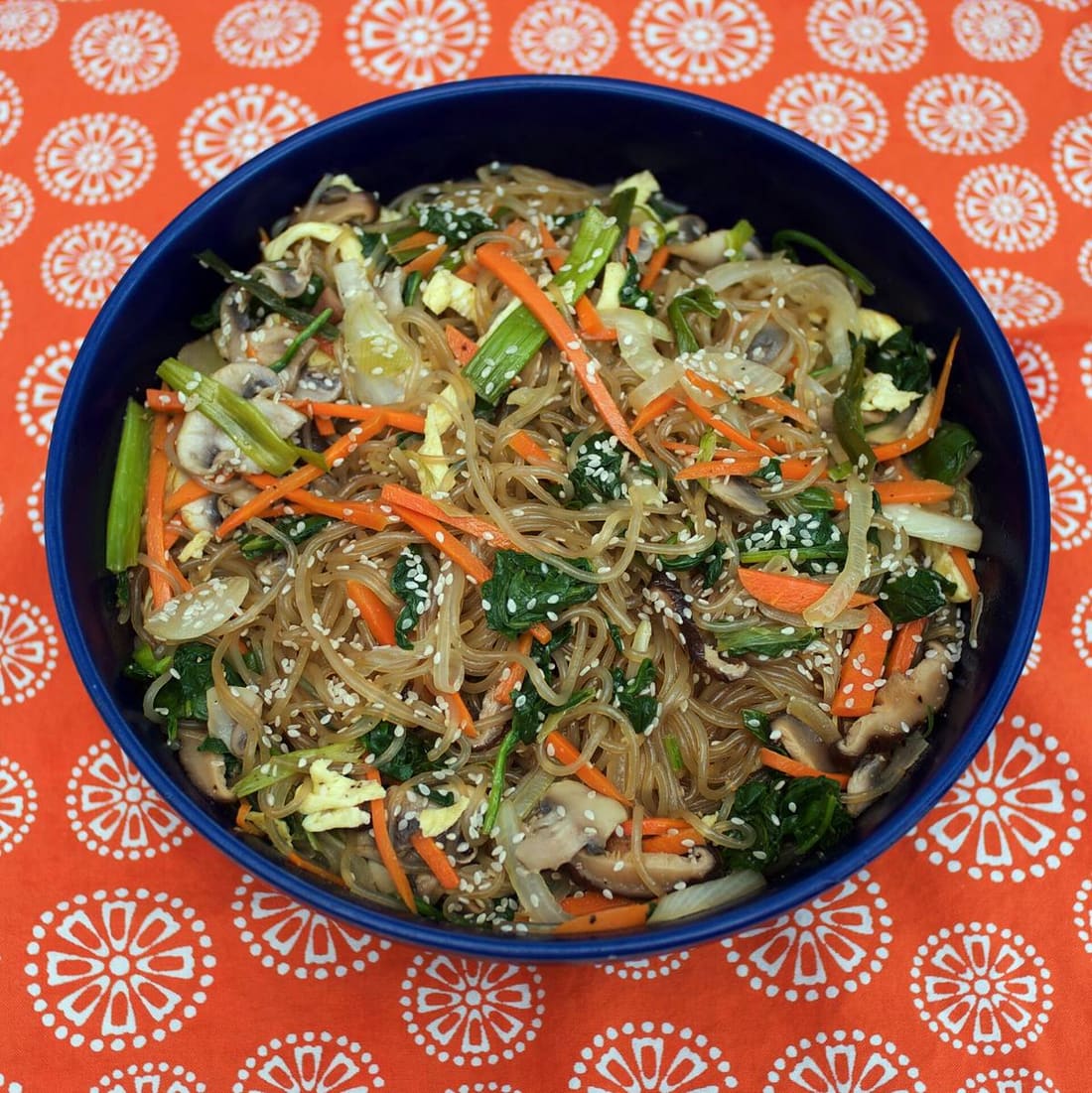
A Minister Mocked for Cooking His Way Into Office
The story usually gets told as a heartwarming discovery — an official invents a dish so good the king promotes him on the spot. What Korea's own court annals actually record reads a lot more like a corruption complaint.
Underground vegetable pits, and a king who wouldn't eat without them
Joseon's official annals describe a court official named Yi Chung (이충, 1568–1619) building large underground pits — essentially primitive winter greenhouses — to grow vegetables out of season during the reign of King Gwanghaegun. Yi had those vegetables turned into side dishes and sent to the palace morning and evening, and the annals record that Gwanghaegun came to wait for food from Yi's household before he'd even pick up his chopsticks. Yi was promoted for it, eventually reaching Ho-jo Panseo — Minister of Taxation, one of Joseon's six ministry heads, roughly equivalent to a modern finance minister.
"Japchae Minister" wasn't a compliment
Courtiers mocked Yi with the nickname japchae-panseo (雜菜判書, "Minister of Mixed Vegetables") — and the label stuck long enough to resurface in the annals again 16 years later, under the next king, Injo: a 1624 entry pairs "Yi Chung's japchae" with another official's noodles as a fixed phrase for officials who'd cooked their way into royal favor. The same story shows up independently in two private historical writings from the period as well — a genuinely unusual amount of cross-referencing for a 400-year-old food anecdote. It wasn't told as a proud origin story at the time. It was court gossip about a man people believed had bribed his way up the ranks with vegetables.
What that record doesn't actually prove
Worth being precise about what's confirmed and what's added later, since most retellings skip this part. Confirmed, across the annals and both private accounts: Yi Chung existed, grew off-season vegetables, won the king's favor through food, and got mocked for it by name. Not confirmed by any of those same records: that "雜菜" (japchae) was a specific named dish Yi invented, rather than a general description of the kind of food he kept sending. The jump from "an official got a nickname referencing mixed vegetables" to "this is the year japchae was invented" is a modern simplification. It isn't fabricated — the record is real — but it's tidier than the record itself actually is.
The Noodles Are the New Part of This Dish
However solid the 17th-century half of the story is, everyone's mental image of japchae — glass noodles as the main event — is a 20th-century addition to a dish that had already existed without them for roughly three hundred years.
Pheasant meat and "whatever you can get" — still no noodles
Korea's oldest surviving cookbook written entirely in Hangul, Eumsik Dimibang (음식디미방, compiled around 1670 by noblewoman Jang Gye-hyang), records a japchae recipe of shredded pheasant meat mixed with a wide assortment of vegetables — its actual instruction is to use whatever you can get, and use all of it. No starch noodles of any kind appear. That detail also complicates a version of the story that circulates in some English-language write-ups, which describe the original dish as meat-free. Korea's own 17th-century cookbook says otherwise — pheasant was already standard, three centuries before dangmyeon showed up.
1919: a factory in Sariwon, and a cheaper way to stretch the dish
Noodle-making technique reportedly reached Korea from China in the late 1800s, and the first dangmyeon factory on record opened in 1912 in Pyongyang, run by a Japanese businessman who'd learned the process from Chinese immigrants. The larger, better-documented turning point came in 1919, when Korean entrepreneur Yang Jae-ha built a large-scale dangmyeon factory, Gwangheung-gongchang, in Sariwon, Hwanghae Province — in what's now North Korea. The 1921 cookbook Joseon Yori Jebeop is the first on record to print a dangmyeon-based japchae recipe, and the dish spread nationally through the 1930s. The reason usually given for adding noodles isn't flavor — it's economy: cheap starch noodles let a household stretch an expensive-meat, labor-heavy vegetable dish further, for less.
"Dangmyeon" (唐麵) literally reads as "Tang noodle" — 唐 originally named the Tang dynasty and later became a general stand-in for "Chinese," the same way English once used "china" as a byword for porcelain.
Built to Need a Whole Kitchen Crew
Japchae's cooking method hasn't really changed since long before noodles existed, and it's a big part of why the dish ended up at banquets instead of everyday dinner tables.
Not one stir-fry — five or six separate ones
Japchae isn't cooked as a single stir-fry. Each ingredient is prepared on its own, often by a different method entirely: spinach is typically blanched rather than stir-fried, carrots and onions and mushrooms are pan-fried separately so none of them bleed color or liquid into each other, beef is marinated and seared on its own, and the dangmyeon itself is boiled separately, rinsed, and often cut down before it ever meets the vegetables. Only at the very end does everything get combined in one bowl and tossed together with soy sauce, sugar, and sesame oil. That's real kitchen labor split across several pans and several timings — not a dish built for one cook working alone.
The color separation isn't just about taste. Carrot orange, spinach green, and egg-garnish yellow (sometimes fried as white and yolk separately, for both colors at once) commonly get read as a nod to obangsaek, Korea's traditional five-direction color system — the same palette logic that shows up across Korean royal court cooking generally.
Weddings, 60th birthdays, and both major holidays — rarely a Tuesday
Japchae shows up at Korean weddings, hwangap (60th-birthday) celebrations, and the home tables set for both Seollal and Chuseok — the two biggest holidays on the calendar — far more consistently than it shows up as a weeknight dish. Part of that is inherited status: this was royal and noble-household food centuries before it was anyone's everyday dinner. Part of it is just practical — a dish that needs several pans and several cooks, and holds up well warm, at room temperature, or cold, is a natural fit for a table a whole family is cooking for a crowd, not a dish one person makes alone on a Tuesday.
The Dish Named for the Part Everyone Now Skips Past
There's a real irony sitting in plain sight here. The dish is named jap-chae — "mixed vegetables" — after a court scandal about a man who won royal favor by cooking vegetables, in a version of the dish that had no noodles in it at all for roughly three hundred years. Ask most people today what japchae is, and the glass noodles come up first, the vegetables second — the newest ingredient in the dish's four-hundred-year history is the one that now gives it its identity, while the ingredient sitting right there in the name has quietly become the supporting act. Yi Chung got mocked for currying favor with vegetables. The noodles that weren't even his idea are most of why anyone still remembers the dish at all.
Comments open soon.