Bulgogi: The Marinated Beef, and the 2,000-Year Legend That's Still Disputed
Bulgogi's origin story gets traced back 2,000 years to a Goguryeo-era grilled dish — except nobody recorded what that dish actually tasted like, and a 2018 fight over whether the word 'bulgogi' is even native Korean still hasn't fully settled either way. Here's what the history actually supports, and the marinade that separates it from every other grilled meat on a Korean table.
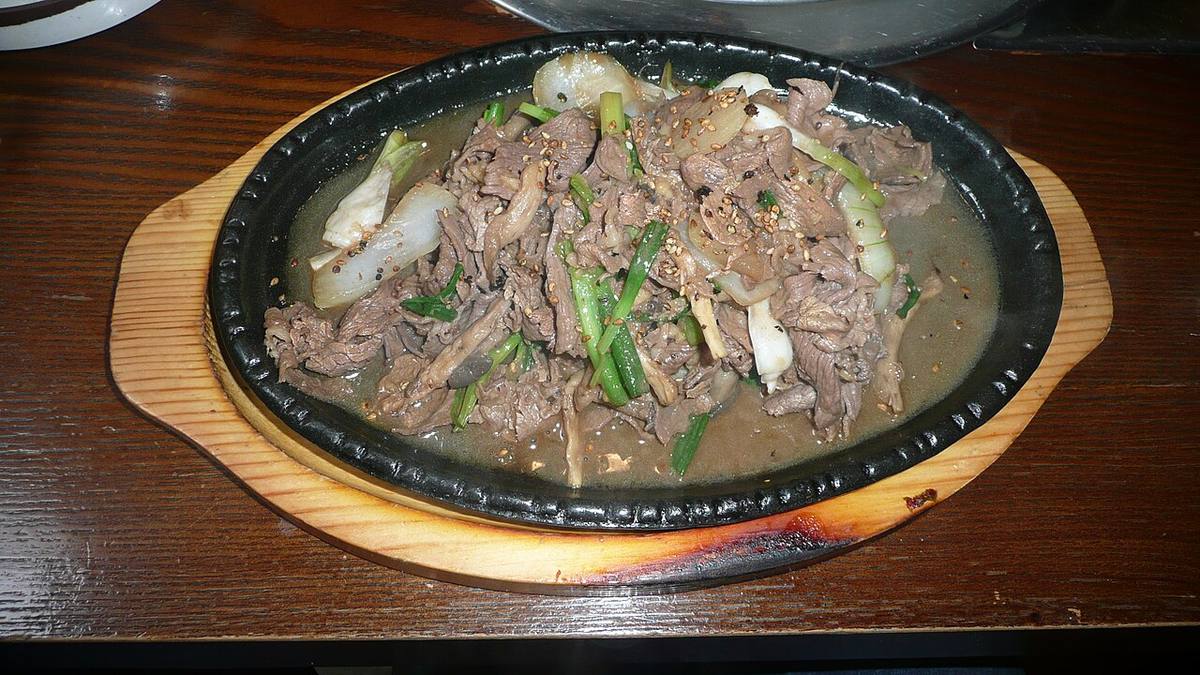
A 2,000-Year Lineage With a Gap in the Middle
Bulgogi's origin story routinely gets pushed back two thousand years, to a Goguryeo-era grilled dish — but the chain connecting that dish to what's on a grill pan tonight has real, openly acknowledged gaps. What historians can support is a lineage claim, not a continuous recipe.
Maekjeok: an ancestor nobody actually wrote the recipe down for
The earliest point in the lineage is maekjeok (맥적), from the Goguryeo kingdom (37 BCE–668 CE). "Maek" was an old term for the peoples of Korea's northeast — the ethnic root Goguryeo grew from — and "jeok" just means grilled meat: skewered, cooked directly over open flame. What doesn't survive from the period is a written recipe. Historians can describe the format — skewered, fire-grilled — but nobody recorded the seasoning or the exact technique, so connecting maekjeok to bulgogi is a claim about lineage, not a matched recipe.
A Buddhist gap, then a revival that kept the seasoning and dropped the technique
Buddhism's rise suppressed meat-eating across the peninsula for centuries after Goguryeo. Grilled-meat culture is generally described as returning during the Goryeo dynasty, under Mongol-era influence, in a dish called seolyamyeok (설야멱, roughly "seeking on a snowy night"). Old accounts describe it seasoned with soy sauce, sesame oil, and garlic — a combination that reads as recognizably close to a modern marinade — but also describe a step, dipping the meat in cold water partway through cooking, that has no equivalent in bulgogi today. The seasoning logic survived the centuries; the technique didn't, not fully.
Neobiani: the royal court's version, and the actual ancestor of today's marinade
By the Joseon dynasty, the dish had become neobiani (너비아니), documented in Sallim Gyeongje (산림경제), a practical-living encyclopedia compiled around the late 1600s to early 1700s: beef sliced thin, tenderized by pounding with the back of a knife, threaded onto bamboo skewers, marinated in soy sauce, and grilled over charcoal once the seasoning had soaked in. That's close to the modern method already. It just wasn't a common dish — neobiani was royal court and noble-household food, in an agricultural economy where beef itself was a restricted, valuable commodity.
The Word Itself Is Newer Than the Legend Suggests
However far back the cooking technique goes, the word "bulgogi" is a 20th-century arrival — and in 2018, a prominent Korean food critic argued in public that it wasn't even a native Korean word to begin with.
A name that only shows up in print in the 1920s
The earliest documented appearance of "불고기" in print is in Hyun Jin-geon's 1922 short story Tarakja (타락자), serialized in the magazine Gaebyeok. It surfaces again in 1935 newspaper coverage, in both Dong-A Ilbo and Maeil Shinbo, describing it as a Pyongyang specialty served at restaurants like Eulsongjeong. Linguist Lee Ki-moon has argued the word began as a Pyongan-province dialect term for neobiani, which spread nationally afterward — an account that would explain why it doesn't turn up in earlier, Seoul-centered records. "Bulgogi" was formally entered into the Korean dictionary in 1947, and into English-language reference by 1961.
2018: a food critic argues the word is a translation of Japanese "yakiniku"
Food critic Hwang Gyo-ik argued that "bulgogi" is actually a translation of Japanese "yakiniku" (야키니쿠/焼き肉) — pointing to the fire-plus-meat word structure as breaking normal Korean compounding patterns, and to what he read as a suspiciously late appearance in print. Linguists pushed back, as the Kyunghyang Shinmun reported in October 2018. Kim Mu-rim and Kim Yang-jin pointed out that "불" (fire) working as a material or method marker is standard Korean word formation — the same pattern shows up in "물회" (water + raw fish). Others noted that yakiniku itself didn't emerge as a distinct word and dish in Japan until roughly the 1940s, too late to have shaped a term already in Korean print by 1922 — and that a direct translation of "yakiniku" would land on "고기구이" (meat-grilling), not "bulgogi," anyway.
The scholars who responded treat Hwang's specific case as unproven. Worth saying plainly: that doesn't mean the word's origin before 1922 is fully settled either — only that the linguists who responded didn't find his specific argument persuasive.
Marinated First: What Actually Makes Bulgogi Bulgogi
Cooking method is where bulgogi actually splits three ways inside Korea, and where it draws its clearest line against the country's other famous grilled meats.
Three regions, three different answers to "how do you cook it"
All three names still show up as genuine regional claims on restaurant signs today, not just menu flavor text:
- Seoul-style — a broth-based hot-pot format: marinated beef goes into a dome-shaped pan or shallow pot with a moat of stock, and glass noodles (dangmyeon) and vegetables simmer alongside it in the broth. Today it's often served as a single portion in a stone pot, sold as "ttukbaegi bulgogi."
- Eonyang-style (Ulsan) — thin beef, hand-chopped and pressed into flattened, patty-like lumps, marinated lightly, then grilled dry and crisp on a grate with no broth at all.
- Gwangyang-style (Jeollanam-do) — thin-sliced beef grilled directly on a grate, with the seasoning adjusted to each diner's own taste at the table rather than fixed in the kitchen beforehand.
Not samgyeopsal, not galbi — marinated before the fire, not after
The clearest line between bulgogi and samgyeopsal, Korea's other default grilled meat, is sequence. Samgyeopsal goes onto the grill raw and unseasoned, straight off the tray, and only meets seasoning afterward — as a dip, gireumjang or ssamjang, that the cooked piece gets dragged through at the table. Bulgogi is marinated first: thin-sliced beef sits in a soy-sauce-based marinade — sugar, garlic, sesame oil, often grated pear or onion for tenderizing — anywhere from 30 minutes to several hours before it goes near heat at all. By the time it's cooking, the flavor is already inside the meat, not waiting to be added at the table.
Galbi draws a second, different line: bone-in short rib, cut thick enough that the marinade needs real time to reach the center of the muscle. Bulgogi is boneless and sliced almost shaved-thin specifically so the marinade penetrates fast and evenly — part of why it can go from fridge to grill in under an hour, where galbi is more often left overnight.
The Korean word that reached English before most Korean food did
By the time Merriam-Webster entered "bulgogi" into English-language reference around 1961, the global K-food wave was still decades away. Korean immigration carried the dish to the US, where it became one of the first Korean food words a lot of non-Koreans learned by name — well before kimchi, bibimbap, or Korean fried chicken had comparable recognition abroad. Which makes for a strange footnote to the 2018 word-origin fight above: whatever "bulgogi" turns out to actually be, it had already been Korea's international calling-card dish for over half a century before anyone publicly argued about where its name came from.
Comments open soon.