Dwaeji Gukbap: Busan's Pork Soup, and the War That Changed It
Busan's everyday bowl wasn't always cloudy and pork-bone rich — Korean War refugees are the reason it is now. Here's the real history, plus the dadaegi-saeujeot-chives ritual locals do before the first spoonful.
A War Refugee Dish, Not a Royal Recipe
Plenty of "traditional" Korean dishes trace back centuries to royal court kitchens. Dwaeji gukbap's story starts in the 1950s, in a city suddenly full of people who had lost everything.
Built by Korean War refugees, not palace cooks
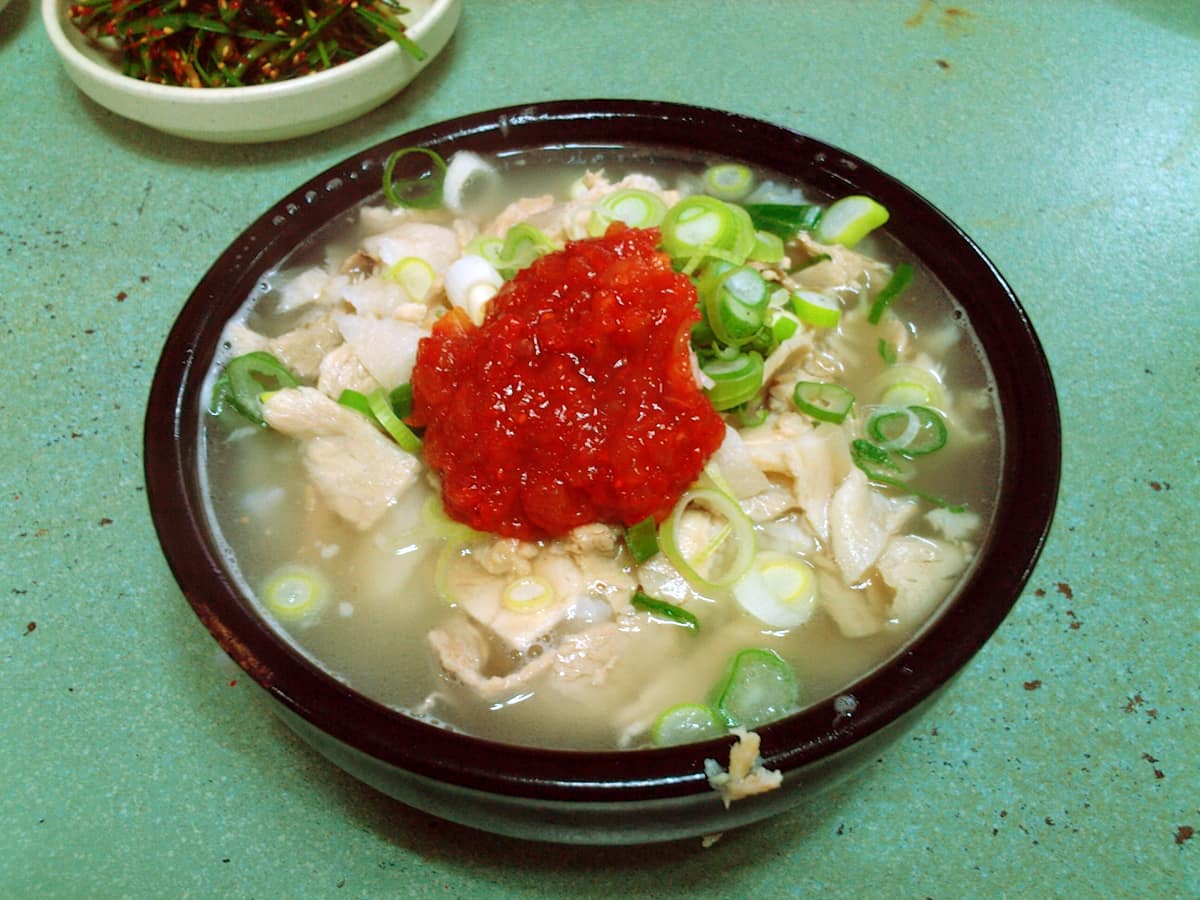
Dwaeji gukbap (돼지국밥) — pork and rice soup — traces back to the Korean War (1950–53), when refugees fleeing the fighting flooded into Busan, many of them arriving from Hamgyong province in the north via the Hungnam evacuation. Money and food were both scarce, and pork was cheap. Refugees brought a food culture from the north that leaned on pork, and combined it with whatever was locally available in wartime Busan — dwaeji gukbap is what came out of that mix.
The soup Busan knew before the war looked nothing like today's bowl — it was a clear, light meat broth, seasoned simply with radish, chili powder, and scallion. The postwar version added pork head meat and offal into the mix, and swapped to a long-simmered pork bone stock in place of the clear broth — a way to stretch a small amount of meat into a filling, inexpensive meal that could feed a lot of hungry people at once. The cloudier, heartier bowl most people now think of as "the" dwaeji gukbap is really the refugee-era adaptation, not the original.
That bulk-stretching logic — bones and offal, built to feed many people cheaply — is exactly why the dish still reads as humble comfort food today. It was designed to be exactly that.
How Busan Actually Eats It
The bowl that reaches your table is deliberately unfinished — seasoning it the rest of the way is the diner's job, not the kitchen's.
Three things you add yourself
Busan gukbap restaurants routinely serve the soup under-seasoned on purpose, with the finishing touches set out separately so each diner can adjust it to their own taste.
- Dadaegi — a chili paste condiment, usually served on the side in its own small dish rather than pre-mixed into the broth. Start with a small spoonful stirred in, and add more if you want more heat.
- Saeujeot — salted, fermented shrimp, spooned in for a salty, briny depth that plain table salt doesn't reach.
- Buchu (garlic chives), sliced thin and added last, for a raw, sharp edge against the rich broth.
Kkakdugi (radish kimchi) usually shows up on the side too — that's the standard order, not an extra you have to ask for.
⚠ Saeujeot is fermented shrimp, and depending on what you order the bowl can contain offal or blood sausage. If you have a shellfish allergy or dietary restrictions, ask the staff what's in your bowl before you order.
Toryeom: the reheating trick that's disappearing
Older gukbap stalls built their whole serving method around toryeom (토렴) — ladling hot broth over the rice, draining it off, and repeating several times to bring cold rice up to temperature before the final bowl goes out. Before rice warmers were standard kitchen equipment, this was how a stall kept rice hot without cooking a fresh pot for every single order. A few old-school Busan shops still do it by hand as a point of pride; most kitchens today just pull rice from a warmer instead, since it gets to the same result faster.
Korean even describes putting together a bowl of gukbap with the verb "만다" (to assemble, or roughly "to roll into") rather than "끓이다" (to boil) — a small linguistic reminder that what happens at your table is assembly, not cooking from scratch.
Not All Dwaeji Gukbap Looks the Same
Order this in three different Busan neighborhoods and you can get three different-looking bowls back.
Cloudy broth vs. clear broth
Within Busan itself, broth style splits roughly into two camps — a cloudy, milky-white broth built on a long-simmered pork bone stock, and a clearer, cleaner-tasting one. Which style a given restaurant serves comes down to house tradition — the bone-to-meat ratio, how long it simmers — more than any strict neighborhood rule.
Miryang, a small city about an hour from Busan by train, has its own well-known style: broth simmered from beef bones instead of pork, giving a clearer, rich stock, with the meat sliced thin rather than in Busan's thicker cuts. The two cities are close enough, and travel between them common enough, that Busan-style shops turn up in Miryang and Miryang-style shops turn up in Busan — this is less a rivalry than two neighboring versions of the same bowl.
What to order: the name tells you what's in the bowl
- Dwaeji gukbap (plain) — sliced pork shoulder or similar lean cuts. The default order.
- Sundae gukbap — swaps in sundae (Korean blood sausage) and head meat.
- Naejang gukbap — built around organ meat.
- Seokkeo gukbap ("mixed") — meat and organs together.
- Modum gukbap ("assorted") — meat, organs, and sundae all in one bowl.
Not sure what to get? Plain dwaeji gukbap is the safe first order — everything else on this list is really just a decision about how much organ meat you want in the bowl.
A bowl that reads like the city
Busan's own city heritage archive describes dwaeji gukbap as a food carrying the city's "투박하고도 진득한" character — blunt and unpolished, but warm underneath. That tracks with how Busan describes itself more broadly: Korea's biggest port city, built up fast by wartime refugees and dockworkers rather than royal tradition. The soup and the city share the same backstory — scarcity, improvisation, and no real interest in looking fancy while doing it.
Comments open soon.