Jajangmyeon: Incheon's Noodles, and the Immigrants Who Invented Them
Jajangmyeon looks like standard Chinese takeout — it's actually a dish Chinese dock laborers invented in 1880s Incheon, and it barely resembles what's actually served in China today. Here's the real history behind the black sauce, plus why Koreans still order it on moving day, and why singles eat it together every April 14.
Dock-Worker Food, Not a Restaurant Invention
Jajangmyeon shows up at graduations, moving days, and every delivery app menu like it's always been there. It actually started as fast, cheap food for exhausted laborers at a single 19th-century port — not a dish any restaurant sat down to design.
A port opens, and Shandong comes across the water
Incheon's port opened to foreign trade in 1883. The following year, Incheon was designated a Qing Chinese concession and China opened a consulate there — the start of what's still the only officially designated Chinatown on the Korean peninsula. More than 90% of the Chinese migrants who arrived in that first wave came from Shandong province, the closest Chinese coastline across the Yellow Sea, and many of them worked the docks. Jajangmyeon started as their food: noodles topped with the fermented soybean paste Shandong laborers already knew from home, sold fast and cheap from carts and roadside pots at the pier — not plated in a sit-down restaurant.
One restaurant, one name, one museum
In 1905, a 22-year-old Chinese migrant named Woo Hee-gwang opened Shandong Hall (산동회관) in Incheon's Chinese concession — part inn, part restaurant, built for Chinese merchants passing through the port. In 1911, marking the Xinhai Revolution that founded the Republic of China, he renamed it Gonghwachun (공화춘, roughly "Spring of the Republic"). Gonghwachun is the restaurant credited with putting the name "jajangmyeon" on a menu for the first time. It closed in 1983, and the same building sat empty for decades before reopening in 2012 as the Jajangmyeon Museum, with the original kitchen and dining hall rebuilt inside.
How It Actually Split From the Chinese Original
Jajangmyeon and its Chinese ancestor, zhajiangmian, share a name and a basic idea. Put a bowl of each side by side, and they're barely the same dish.
One ingredient made it black, sweet, and Korean
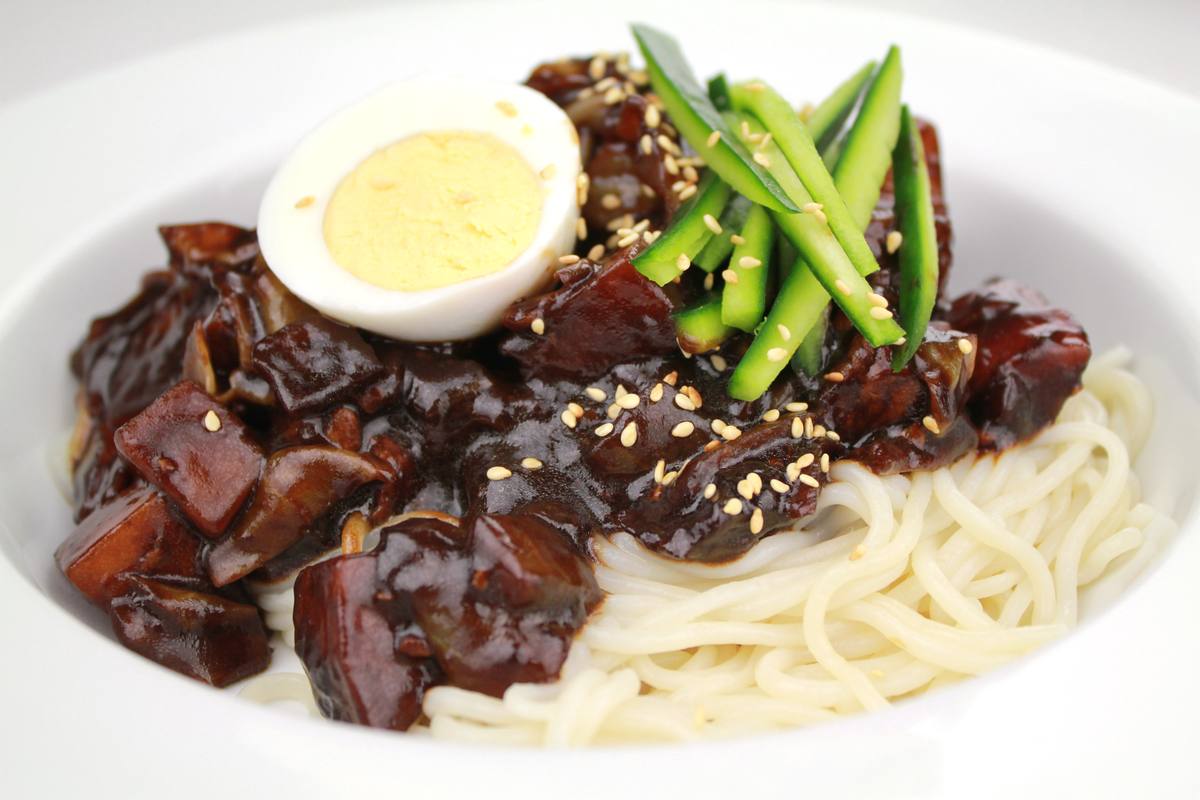
Chinese zhajiangmian is built on tianmianjiang, a salty, light-brown fermented soybean paste — the flavor stays close to savory. Korean cooks working with the Shandong-style paste, chunjang, started stirring caramel into it, which pushed the color toward near-black and the flavor toward sweet instead of salty. Modern jajangmyeon layers that caramelized paste with diced pork belly, onion, and zucchini into a thick, glossy sauce poured over wheat noodles — visually and on the tongue, a different dish from what's actually served in China today.
A 1948 factory product locked the recipe in nationwide
The caramel-black style wasn't just one kitchen's preference — it got mass-produced. In 1948, a Chinese-Korean businessman named Wang Song-san founded Yonghwa Jangyu and began selling "Lion-brand" chunjang (사자표 춘장): a sweet Chinese-style bean paste with caramel coloring added, sold nationally rather than made from scratch in every kitchen. That product is a large part of why the sweeter, blacker style became the default everywhere in Korea instead of staying one region's variation. Government "mixed-grain" campaigns through the 1960s and 70s, meant to stretch scarce rice supplies by encouraging wheat noodles and flour instead, pushed jajangmyeon's popularity even further — Korea now eats an estimated 7 million servings of it a day, across roughly 24,000 Chinese restaurants nationwide.
The Occasions That Call for It, Specifically
Plenty of Korean dishes get eaten daily without a second thought. Jajangmyeon is the one people specifically reach for on a short list of unrelated occasions — and the reasons are almost all logistical, not sentimental.
Graduation lunch, and moving-day dinner
Eating jajangmyeon after a graduation or school entrance ceremony is a decades-old family ritual — it used to be a genuine treat, back when a Chinese restaurant meal cost more than most home cooking. Moving day runs on the opposite logic: nobody wants to cook in a kitchen that isn't unpacked yet, Chinese restaurants had the fastest and most established delivery networks in the country, and a bowl of noodles leaves nothing to wash afterward. Both occasions land on the same dish for almost opposite reasons.
The metal delivery box (철가방) a driver hands over at the door is specifically tied to Chinese-restaurant delivery in Korea — it functions as shorthand for jajangmyeon culture on its own.
Black Day, and the dish invented just to avoid choosing
April 14 is Black Day — an unofficial, tongue-in-cheek holiday for people with no one to celebrate Valentine's Day (Feb. 14) or White Day (Mar. 14) with. Since the 1990s, single people have marked it by wearing black and eating jajangmyeon together, in on the joke about the commercialized couple holidays that came before it; restaurants report jajangmyeon sales spiking by 20 to 30% on the day itself. The dish also causes a permanent, year-round indecision: choosing between jajangmyeon and jjamppong (spicy seafood noodle soup) is such a common dilemma that someone eventually patented a fix — jjamjjamyeon (짬짜면), a single bowl split down the middle with both, which spread to Chinese restaurants nationwide after debuting around 2000.
The neighborhood that's still there
Incheon's Chinatown remains the only neighborhood in Korea with that official designation, built on the same ground the Qing concession occupied starting in 1884. Jajangmyeon restaurants line its main street, the Jajangmyeon Museum sits inside Gonghwachun's old building, and the Chinese-Korean (hwagyo) community the dish came from never really left. The noodles spread to every corner of the country; the port that invented them kept the receipts.
Comments open soon.