Naengmyeon: The Summer Noodles That Started Out as a Winter Dish
Korea's go-to hot-weather noodles are actually a northern winter tradition that a war carried south — splitting the whole way into two completely different bowls. Here's the real Pyongyang-vs-Hamhung story, plus the scissors-vinegar-mustard rules locals actually follow.
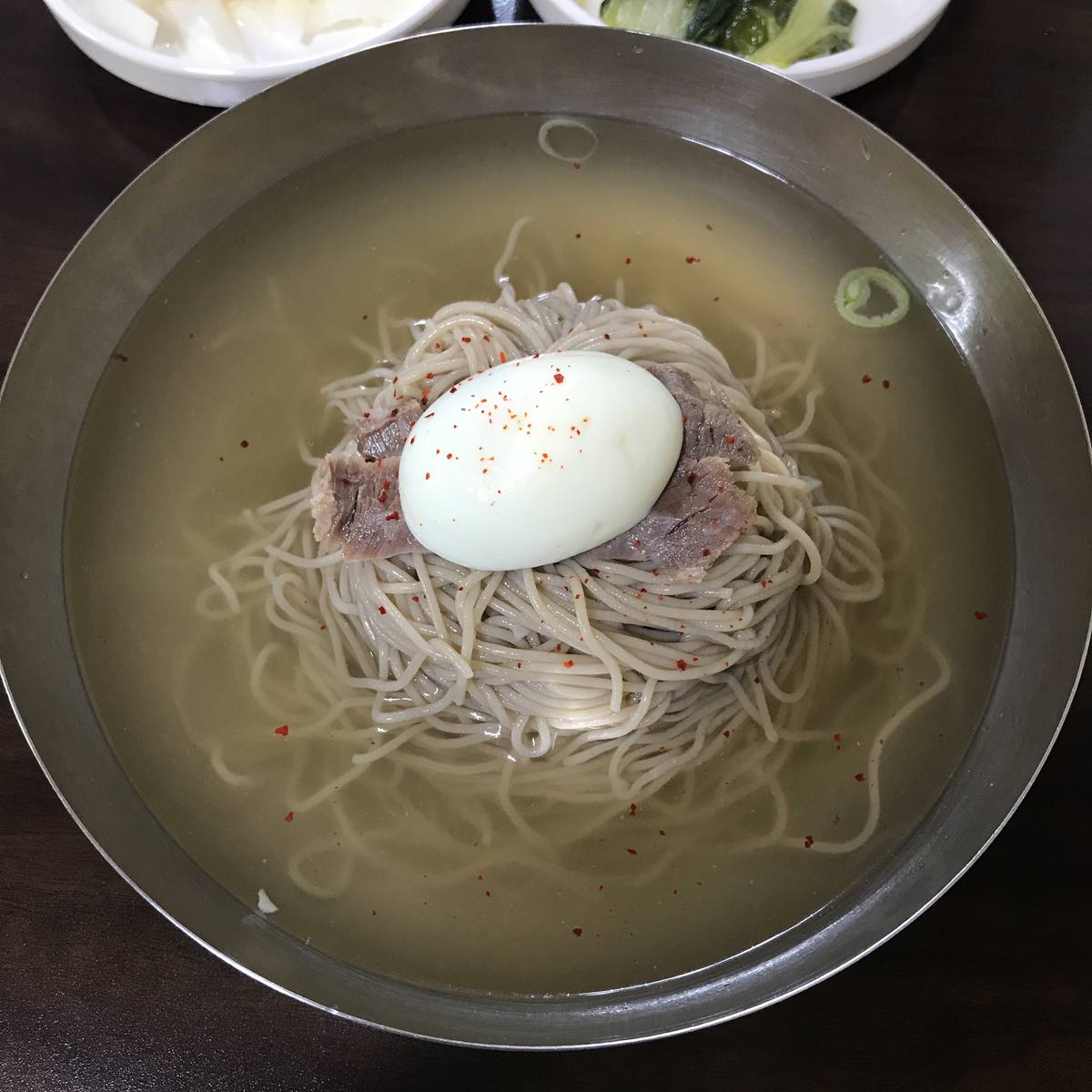
One Name, Two Completely Different Bowls
Order "naengmyeon" in Korea and the kitchen still needs one more piece of information — because the dish splits into two versions that barely resemble each other.
Pyongyang-style: mostly buckwheat, built on broth
Pyongyang naengmyeon — the version most people picture first — uses noodles that are mostly buckwheat, commonly cited at around 70% buckwheat to 30% starch, giving them a thin, slightly rough, delicate texture that breaks rather than stretches. They're served ice-cold in a broth that's usually clear beef stock mixed with dongchimi (watery, tangy radish kimchi) brine.
Koreans often describe that broth as seumseumhada (슴슴하다) — mild, faint, almost bland on the first spoonful. That's not a flaw in the recipe; it's the point. The flavor is quiet enough that most regulars say it takes a few visits before it actually clicks.
Hamhung-style: potato starch, no broth, all heat
Hamhung naengmyeon comes from further north and east, in what was Hamgyong province, and shares almost nothing with the Pyongyang version except the name. The noodles are made almost entirely of potato or sweet-potato starch instead of buckwheat — springier, chewier, and noticeably harder to bite through. There's no broth involved at all: the noodles get tossed directly in a spicy gochujang-based dressing.
In the South today this version is usually just called bibim naengmyeon ("mixed" or "tossed" cold noodles) — the regional name mostly survives among people who trace their family back to Hamhung itself.
How a War Sent Both Styles South
Neither style started in South Korea. Pyongyang's version got a decades-long head start before the fighting — Hamhung's arrived because of it.
Pyongyang-style had already reached Seoul in the 1920s
Large naengmyeon restaurants serving the Pyongyang style were already operating in Seoul under Japanese colonial rule, including Pyeongyangru and Bubyeokru in Jongno and Baekyangru near Gwanggyo — decades before the Korean War started. The dish was already a known quantity nationally; the war didn't invent it.
What the war actually did: the Hungnam evacuation
In December 1950, the U.S.-led evacuation of Hungnam — a port next to Hamhung, sometimes called the "Christmas Miracle" — pulled roughly 100,000 troops and about 100,000 civilian refugees out by sea over some two weeks, dropping most of them in Busan and other southern ports. Many were from Hamgyong province, Hamhung included, and once the front line hardened into today's DMZ, going home stopped being an option.
Displaced families settled into Seoul neighborhoods like Ojang-dong, Pil-dong, Jangchung-dong, and around Dongdaemun, along with Busan — and a lot of them made a living the only way they had a head start on, opening naengmyeon restaurants one after another. That's the actual moment Hamhung-style bibim naengmyeon reached the South, and it's also what turned naengmyeon overall from "a Pyongyang specialty a few Seoul restaurants serve" into a nationwide dish. A handful of long-running restaurants in that tradition, including Woo Lae Oak and Eulji Myeonok, are still open today — some now run by the founders' descendants.
Cold Noodles for the Hottest Days — Which Runs Backward From the Rulebook
Korean food culture actually has a named principle for beating summer heat, and naengmyeon doesn't follow it.
Iyeolchiyeol says fight heat with heat. Naengmyeon disagrees.
Iyeolchiyeol (이열치열, "use heat to control heat") is the logic behind samgyetang — the steaming ginseng-and-chicken soup Koreans eat on sambok, the three hottest stretches of summer (chobok, jungbok, and malbok, spaced about ten days apart from mid-July into August). The idea: sweat it out with something hot, cool down as the sweat evaporates, and replace what the heat drained.
Naengmyeon is what a huge number of people reach for during that exact same stretch of summer instead — direct cold relief, no sweating required. Korea doesn't really treat this as a contradiction so much as two separate, both-legitimate answers to the same brutal week; plenty of people eat both within a few days of each other.
The twist: it wasn't a summer dish to begin with
In its home region, naengmyeon was traditionally a winter food, not a summer one. Buckwheat was planted in early summer and harvested last, in late autumn, and dongchimi reaches its best, coldest, most fermented state deep in winter — so that's when the dish was originally built to be eaten. Northerners describe the "real" way to eat it as sitting on a hot ondol (heated floor) in the dead of winter, slurping broth so cold it makes your teeth ache — a hot room and an ice-cold bowl, not hot weather and cold relief.
The summer association took hold only after the dish spread nationwide in the South. These days naengmyeon restaurants stay open and busy year-round — business doesn't shut down once fall arrives, which is more than you can say for a lot of dishes that actually are seasonal.
How Locals Actually Eat It
A few table habits look optional to a first-timer but are really style-specific rules — and one is genuinely just etiquette.
Scissors: refused at one table, handed to you unasked at the next
Long noodles traditionally symbolize a long life, which is why serious Pyongyang-style restaurants won't offer scissors at all — cutting them is treated as missing the point, and the kitchen wants you to taste the buckwheat strand break naturally in your mouth. Hamhung-style tables run the opposite rule: scissors usually show up before you even ask, since the thicker, chewier starch noodles are genuinely harder to manage without them.
Neither rule is universal nationwide — but if a server hesitates when you ask for scissors, you've probably landed at a Pyongyang-style purist's restaurant.
Vinegar, mustard, and the broth itself
Vinegar and mustard usually arrive on the table but aren't mandatory — most guides suggest tasting the noodles plain first, then adding vinegar for brightness and a little mustard for a sinus-clearing kick, both in small amounts. (Some Pyongyang purists skip both entirely and let the broth speak for itself.) One often-cited explanation for why they became standard table condiments in the first place is food safety rather than flavor — vinegar and mustard both have a mild antibacterial effect, useful before refrigeration was standard.
Unlike some noodle soups where the broth is optional, lifting the bowl and drinking the broth directly is considered the normal, proper way to finish a bowl of mul naengmyeon — it's seasoned to be drunk, not just to carry the noodles.
A bowl that carries a hometown you can't go back to
For the refugees who carried it south, and the families who came after them, naengmyeon was never really about flavor preference. It became the closest thing to a way home once home stopped being reachable — a taste memory kept as exact as possible on purpose, because for people who lost the place itself, the recipe was one of the only pieces still within reach. That's part of why Pyongyang-style kitchens are famously stubborn about changing anything: some things aren't there to be improved on, just preserved.
Comments open soon.