Samgyeopsal: How Korea's Favorite Grilled Pork Actually Gets Eaten
Grilled at the table, wrapped in lettuce, gone in one bite — here's how the wrap actually goes together, and the unwritten rules that separate a regular from a first-timer.
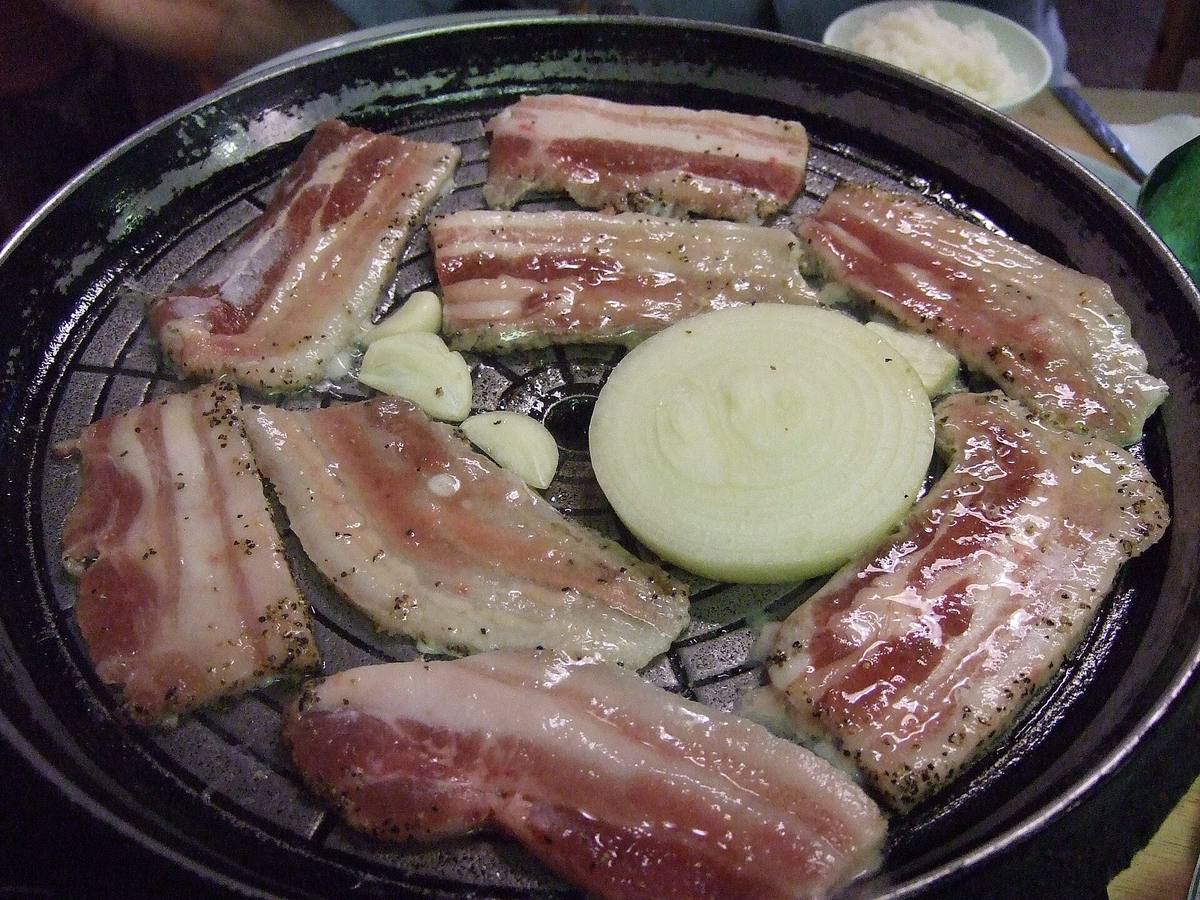
The Meat Behind Korea's After-Work Culture
Samgyeopsal wasn't always the default order — it became one for reasons closer to economics than tradition.
Why it's cheap, popular, and everywhere
The name literally means "three-layer meat," for the alternating bands of skin, fat, and meat visible in a raw slice. It's been a fixture of Korean grilling since the 1960s, but its popularity really took off later — pork got cheaper domestically after export deals with Japan fell through, and a nationwide beef shortage in the 1980s pushed more households toward pork instead. As the fattier, less prized cut at the time, pork belly was priced low enough to become the everyday choice, and it never really gave up that spot.
Since the 1980s, grilled pork belly has doubled as anju — food meant to be eaten alongside drinks — and it's the centerpiece of hoesik, the after-work team dinners where coworkers grill, drink, and unwind together. It's less a special-occasion food than a background constant: Koreans are said to eat it on average about once every four days.
How to Actually Eat It
The grilling is only half the process — what you do with the cooked piece is the part visitors usually improvise.
Building a proper ssam (wrap)
Take a lettuce leaf — add a perilla leaf on top if the table has them — and hold it flat and open in your palm, not folded like a taco shell. Place a piece of grilled meat in the center, add a thin slice of raw garlic if you like it, and a small dab of ssamjang. A dab, not a spoonful — it's there to season the bite, not dominate it. Some tables add a little scallion salad or fresh kimchi before folding the leaf closed like a small parcel.
A ssam is a one-bite food — the whole wrap goes in at once. Biting it in half over the plate is the one habit that reliably marks out a first-timer, mostly because an overstuffed wrap falls apart the moment you bite into it.
If a wrap feels too big to fit in one bite, the fix is less filling next time, not a smaller bite now.
Before it even gets to the wrap stage
A lot of visitors go straight for ssamjang and miss gireumjang — a small dish of sesame oil and salt (sometimes with a pinch of pepper) that the meat gets dipped in first, before it's wrapped in anything. It's the simpler, milder option, and plenty of regulars dip in gireumjang and build a ssamjang-based wrap, rather than treating it as one or the other.
- Most grill restaurants require a minimum order of two servings, even for a solo diner — the grill and charcoal cost the same to fire up regardless of headcount
- At everyday, affordable places, the table gets tongs and scissors and one person — often whoever's most experienced — mans the grill; pricier restaurants often have staff grill and cut it for you
- The scissors are for cutting the meat into bite-sized pieces on the grill itself, not a utensil for your plate
March 3rd is officially Samgyeopsal Day
If you're in Korea on March 3rd and see restaurant discounts and supermarket sales on pork belly, that's Samgyeopsal Day (삼겹살 데이) — and it's newer than it looks. A regional livestock cooperative created it in 2003 as a straightforward marketing push, built entirely around the pun that "3" (sam) is also the first syllable of samgyeopsal. It caught on anyway: restaurants and grocery chains nationwide still treat it as a genuine yearly event, not just an old ad campaign that stuck.
Comments open soon.