Samgyetang: The Boiling Soup Korea Eats to Beat the Heat
Korea's answer to its three worst summer days isn't a cold drink — it's a whole young chicken stuffed with ginseng, rice, and jujube, simmered into a bowl you eat while sweating on purpose. Here's the sweat-and-evaporation logic behind fighting heat with heat (and where it stops working), the naming flip almost nobody remembers happening, and why the same restaurants keep the lines going straight through winter.
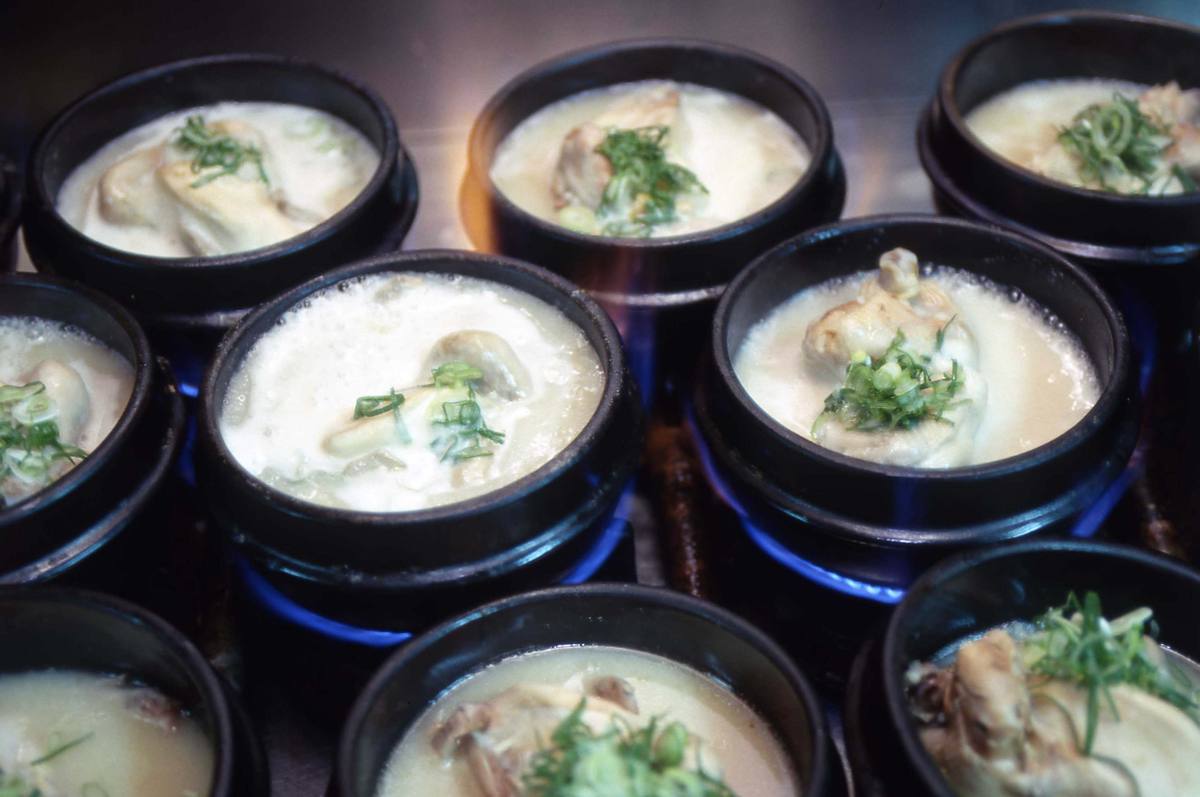
The Line Forms for Boiling Soup, on the Worst Day of the Year
Pick the single most miserable, sun-flattened day of a Korean summer, and the move isn't iced coffee or a cold drink. It's sitting down to a pot of soup that's still bubbling when it lands on the table.
Iyeolchiyeol: fighting heat with heat
The principle behind that pot is iyeolchiyeol (이열치열, "use heat to control heat"), and it's less superstition than it sounds. In extreme heat, the body is already sweating just to keep up, and a bowl of hot soup pushes that further — the usual explanation is that it's the sweat evaporating off the skin afterward, not the soup itself, that pulls body temperature back down, while the chicken and broth are traditionally credited with replacing the energy the heat already drained. Researchers who've compared hot and cold drinks in hot weather have found a version of the same mechanism at work: a hot drink can trigger enough extra sweating that, once it evaporates, a person ends up cooler than they would after a cold one. That only holds when the sweat can actually evaporate, which is much harder in humid weather.
⚠ This describes a food tradition and one explanation for it. It isn't health or heat-safety advice. Hot food isn't a substitute for water, shade and rest on a dangerously hot day; if you're elderly, pregnant, prone to heat illness or on medication, check with a doctor, and follow local heat warnings.
Mori's Korea already covered naengmyeon, the ice-cold noodle dish a huge number of people reach for during this exact same stretch of summer — direct relief, no sweating required, and (as that article gets into) not even a summer dish originally. Samgyetang is the other half of the same week, and the one that actually follows the rule iyeolchiyeol is named for, instead of quietly working around it.
What looks backwards to almost everyone visiting
Foreign visitors who time a trip for peak Korean summer tend to expect the local move to be something cold — patbingsu, iced coffee, anything but heat. Finding a line outside a restaurant serving soup that's still steaming, on the single most brutal day of the year, is a genuine double-take moment for a lot of travelers, and it shows up constantly in foreign food writing about Korea as one of the country's more counterintuitive habits. The usual explanation isn't a higher heat tolerance among Koreans but the sweat-and-evaporate logic above, which holds up best in dry heat, and generations of brutal summers are what taught people to trust it.
Sambok, and a Recipe That Predates the Word for It
The three days built around this dish aren't fixed on a calendar the way a national holiday is. And the dish itself is older than its own name.
Sambok: three hot spells that move every year
Chobok, jungbok, and malbok are set the traditional way rather than by fixed calendar date: chobok falls on the third gyeong-day (庚, one of the ten heavenly stems that repeat every ten days in Korea's traditional 60-day cycle) after the summer solstice, jungbok on the fourth gyeong-day after that, and malbok on the first gyeong-day after ipchu, the start of autumn on the same traditional calendar. Because gyeong-days land every ten days, chobok and jungbok are reliably ten days apart — but malbok is anchored to ipchu instead of just continuing that same count, so some years land a rarer twenty-day gap between jungbok and malbok instead, a quirk Koreans call wolbok (월복).
The character 伏 in "bok" means roughly "submit" or "yield." One traditional explanation ties it to five-element calendar logic: summer's fire force is considered strong enough that autumn's incoming metal force has to yield to it three separate times before autumn can actually take hold — sambok, three yieldings, not three meals.
From plain baeksuk to a spoonful of ginseng powder
Whole boiled chicken — baeksuk, no ginseng, no rice stuffing — is old, ordinary Korean food with no single invention date. The specific stuffed-and-simmered version now called samgyetang is much younger and considerably easier to trace: cookbook author Bang Sin-yeong's Joseon Yorijaebeop (조선요리제법) contains an early-1920s recipe instructing readers to gut a chicken and stuff the cavity with three spoons of glutinous rice and one spoon of ginseng powder — the earliest written trace of the dish taking its current shape. A 1942 cookbook, Joseon Musang Sinsik Yorijebeop, describes a version of it as yeongye-baeksuk (young chicken baeksuk) and specifically recommends it as the best restorative food for summer, adding that anyone who already eats ginseng could boil a whole root in with the chicken for an even better result.
The Name Changed Twice, and the Ritual Comes From a Rice Paddy
What people actually called this dish took decades to settle — and the reason this specific week became its calendar slot has nothing to do with the recipe at all.
Gyesamtang first, samgyetang later — the name flip
Restaurants selling this dish through the 1950s, after liberation, called it gyesamtang (계삼탕) — chicken first, ginseng second, back when ginseng powder was still a minor add-in rather than the headline ingredient. After the Korean War, into the 1960s, wider refrigeration and looser regulation made whole dried ginseng root practical to stock and distribute instead of just powder. As kitchens switched to stuffing a whole root inside the bird, the ingredient now doing the heavy lifting — and costing the most — moved to the front of the name. Gyesamtang became samgyetang: ginseng, then chicken. Some older Koreans still call it by the old name out of habit.
Where the yearly ritual actually comes from
Before mechanized farming became standard, sambok landed at the worst possible time for rice farmers. The final, most exhausting round of weeding — sebeol gimaegi (세벌 김매기), the third pass through the paddy — had to be finished before Baekjung (백중), the 15th day of the seventh lunar month. Workers hit that deadline running on empty, right as the heat peaked, and animal protein was the traditional remedy — eaten as much like medicine as like food. That farm-labor emergency, not the recipe itself, is where the habit of treating this particular week as boyangsik season actually comes from.
A restaurant open since 1983 that never really closes for the season
Tosokchon Samgyetang, running in Seoul's Seochon neighborhood since 1983, is one of the country's best-known versions of this dish — generally open daily, with lines that form in every season, not just summer, and, by Korean press accounts, a longtime regular in ex-President Roh Moo-hyun. Whatever the sambok calendar says about which three days matter most, the restaurants actually serving this soup don't slow down once autumn arrives.
Comments open soon.