Bulguksa and Seokguram: The Parts That Are Actually 1,300 Years Old
Korea's most-visited UNESCO temple pair looks like one unbroken ancient site — but the wooden halls you're walking through were rebuilt in a 1970s restoration, and the Buddha statue everyone tries to photograph has been sealed behind glass since around the same decade.
One Mountain, Two Separate UNESCO Sites
Bulguksa and Seokguram get photographed side by side so often that first-time visitors assume they're next to each other. They're not — and that single assumption is the most common planning mistake here.
One UNESCO listing, two different stops on the mountain
Bulguksa and Seokguram were inscribed together as a single UNESCO World Heritage listing in 1995 — likely why the two names get treated as one destination. On the ground they're separate places on the slopes of Mt. Tohamsan. Bulguksa, lower down, is the temple complex most people picture: courtyards, stone pagodas, wooden halls. Seokguram is the grotto shrine higher up the same mountain, roughly 4 kilometers further by road.
A shuttle bus (bus 12) has run from Bulguksa's parking area roughly every 30 minutes and covers the distance in about 20 minutes, for under $2. A hiking trail also connects the two — a well-maintained mountain path of about 3 kilometers, roughly 1 to 1.5 hours on foot — and locals often recommend it over the bus on a clear day. Either way, treat it as a second leg of the trip, not a five-minute walk. Bus times, fares and trail conditions change, so confirm them on site.
Budget half a day, not an hour
Bulguksa's courtyards are worth walking slowly. Seokguram is the opposite: once you arrive, you view the statue for a couple of minutes from a fixed spot rather than wandering through it, so the actual "sightseeing" time at the grotto itself is short. The real value of the Seokguram half of the trip is the mountain approach and setting, not a long stay once you're there — plan around both stops plus the travel between them, and the day adds up to something closer to half a day than a quick add-on to Bulguksa.
The Stone Is Original. Most of the Wood Isn't.
Every photo of Bulguksa's tiled roofs and painted wooden halls reads as ancient. What's actually old on this site is mostly underneath and around them, not the halls themselves.
A temple finished by the state, not the man who designed it
Bulguksa's founding is traditionally dated to 528, under King Beopheung, but the temple visitors recognize today took shape starting in 751, when Silla's chief minister, Kim Daeseong, began a major reconstruction. He died in 774 with the work unfinished, and the Silla state completed it after him. A legend recorded in the 13th-century chronicle Samguk Yusa adds a folklore layer on top of that history: Kim Daeseong was said to have built Bulguksa for his parents in this life, and Seokguram for his parents in a previous one.
1593 burned it down. 1969 rebuilt it.
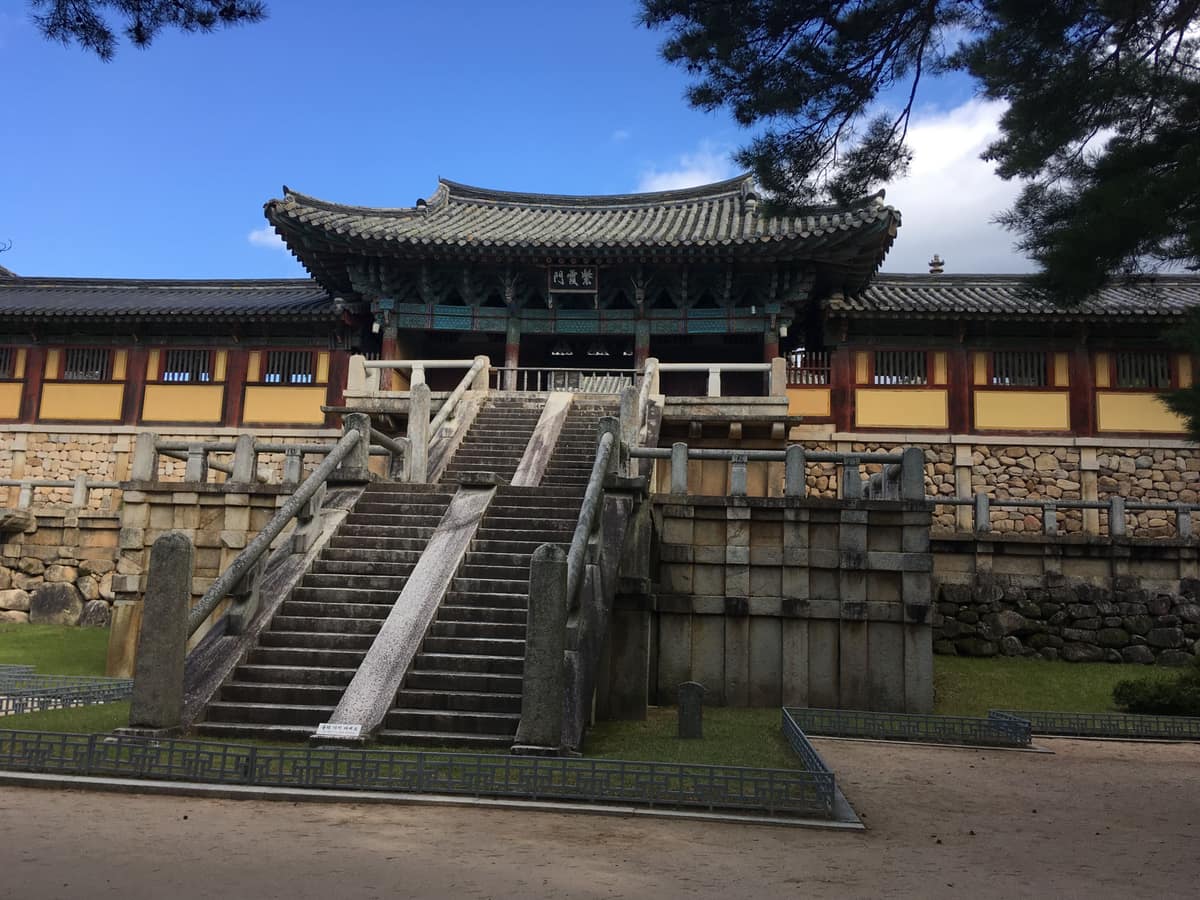
Invading Japanese forces set fire to Bulguksa in 1593, during the Imjin War, and every wooden structure on the site was lost. What survived was the stonework — the Dabotap and Seokgatap pagodas, the Cheongungyo (Blue Cloud Bridge) stone stairway, and the terraces the halls stand on are genuine 8th-century Silla construction, still in their original place. Partial rebuilding happened in 1604 and again through the 1700s, but the wooden halls tourists photograph today mostly date to a single government restoration ordered by President Park Chung-hee, carried out from 1969 to 1973, which rebuilt or renovated roughly 24 buildings.
The stone pagodas, the stone bridge stairway, and the stone terraces are the real 1,300-year-old material. The painted wooden halls sitting on and behind them are around 50 years old — a careful reconstruction, not the original Silla buildings.
Why You Can't Get Close to the Buddha
Seokguram disappoints some visitors for reasons that have nothing to do with the statue itself, and everything to do with what's protecting it.
Not a natural cave — a built one
"Grotto" makes Seokguram sound like a cave someone found and decorated. It's the reverse: Silla builders cut and fitted over 360 granite blocks into a domed chamber using a corbelled technique — stone slabs layered inward in place of a true arch — locked together so precisely that the dome held watertight without any mortar, then covered the whole structure in an earthen mound. That earth covering wasn't just camouflage; it was the original climate control, keeping the chamber's temperature and humidity stable for centuries before anyone added mechanical systems. Completed in 774 under the same patron as Bulguksa's reconstruction, Kim Daeseong, the grotto's seated Buddha faces the sea, surrounded by carved reliefs of bodhisattvas and disciples on the chamber walls.
The glass wall is conservation, not stinginess
Visitors today view the Buddha from roughly 5 meters back, through a glass wall, from the front only — no walking around it, no photography, with signs in Korean and English enforcing both. The barrier exists because of a preservation problem, and something of an ironic one: a Japanese colonial-era restoration in 1913–1915 sealed the original structure inside an outer concrete dome, which trapped moisture and triggered condensation and mold — undoing the passive climate control the earth mound had provided for over a thousand years. A 1960s Korean restoration added a second concrete dome with an air gap and mechanical humidity control to fix that, and the glass wall went up in the mid-1970s to stop visitors' own body heat and breath from undoing the fix a second time. The barrier that disappoints photographers today is the same one that's kept the statue intact.
Two pagodas that are really one idea
Dabotap and Seokgatap, the two stone pagodas standing in Bulguksa's courtyard, look like a mismatched pair — one ornate and multi-tiered, one plain and symmetrical. They're built to be read together: a scene from the Lotus Sutra in which Dabo, a Buddha who had already reached enlightenment in the past, appears beside Sakyamuni, the present Buddha, to confirm that his teaching is correct. Dabotap represents that earlier Buddha, Seokgatap the present one — a complementary pair, not a mismatch. Dabotap in particular is more familiar to Koreans than most realize: it's the pagoda pictured on the country's 10-won coin, handled without a second thought.
Comments open soon.