Haenyeo: The Real, Dangerous Job Behind Jeju's Most Famous Image
Jeju's haenyeo show up on postcards and souvenir shelves as folklore — but the women in the wetsuits are real, most in their 60s to 80s, and they still free-dive for a living without oxygen tanks. Their numbers are dropping fast enough that the tradition may not survive this generation.
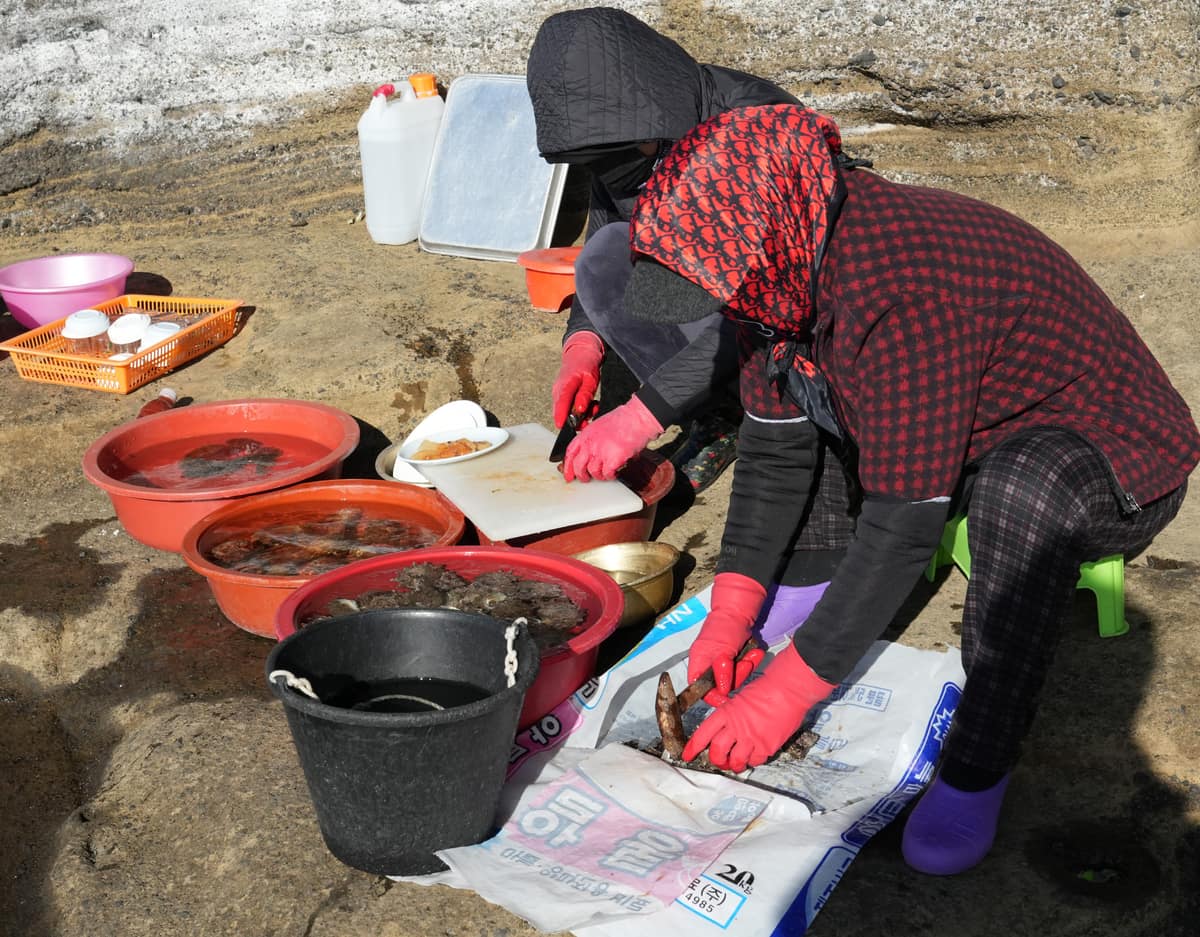
Not Folklore, Not a Mascot — a Real, Working Job
Haenyeo turn up on Jeju tote bags, murals, and tourism-board posters everywhere, somewhere between folk legend and mermaid branding. The women actually wearing the wetsuits are doing one of the more physically demanding jobs left in Korea — today, not in a museum diorama.
No oxygen tanks — and that's by design, not by poverty
Haenyeo dive for abalone, sea urchin, conch, and seaweed on a single held breath, working depths that typically run around 10 meters and sometimes reach 20, staying under anywhere from about a minute to three minutes at a time. It isn't a skills or equipment gap: Korean fisheries rules don't allow unlicensed scuba gear for shellfish harvesting on Jeju, and the restriction is generally explained as a conservation measure: compressed air would let divers stay down long enough to strip the reefs bare. Haenyeo communities also self-police catch sizes and seasonal no-take windows by species. UNESCO's own inscription credits the practice as an eco-friendly, sustainable harvesting method — not a primitive one.
Minimal gear, five to six hours a day
Modern haenyeo wear wetsuits graded by season — about 4mm thick in summer, 6 to 7mm in winter — a fairly recent upgrade from the plain cotton diving clothes worn before rubber suits became standard in the 1970s. Swim goggles, introduced in the early 1900s, stretched their underwater visibility from roughly 2-3 meters to about 20. The only other essential piece of kit is the tewak, a floating buoy that carries the catch net and marks a diver's position on the surface. With this gear, haenyeo still put in roughly five to six hours a day in the water, across about 90 working days spread through the year — and every time one resurfaces, she exhales in the sharp, practiced whistle known as sumbisori before going back under.
The History Most Visitors on Jeju Never Get Told
Souvenir shops sell haenyeo as a gentle, photogenic tradition. In January 1932, roughly seventeen thousand of them organized one of the largest protests in Korean history — and most tourists leave the island without ever hearing about it.
A cooperative, a foreign buyer, and a 40% markdown
By the early 1930s, Jeju's haenyeo were required to sell their harvest through the Jamsu Fisheries Cooperative, a body colonial Japan controlled. In late 1931, the cooperative handed an exclusive purchasing contract to a Japanese trading company that then bought the divers' catch at roughly 40% below market price. Haenyeo organized against it — a campaign that started with a few hundred divers and grew, joined by women and farmers from neighboring districts, into 238 separate protest actions between mid-1931 and January 1932, involving more than 17,000 participants in total. It's recorded as the largest fisherfolk-led protest movement in Korean history, and the only nationwide anti-colonial movement of the era led by women.
Sickles against colonial police, and a death in custody
In January 1932, over a thousand haenyeo gathered at Sehwa's market carrying the tools of their own trade — abalone picks and small seaweed sickles — and marched in open defiance of the colonial government. One account of the protest records them shouting that they'd meet swords with their own deaths rather than back down. Colonial police arrested more than 100 haenyeo in the aftermath. Three organizers — Bu Chun-hwa, Kim Ok-ryeon, and Bu Deok-ryang — were held for months; Bu Deok-ryang died from injuries sustained in custody at 28. Decades later, the Korean government posthumously awarded all three the Order of Merit for National Foundation.
A Tradition Now Racing Its Own Clock
Jeju counted more than 20,000 haenyeo through the 1960s. What's left of that number today could disappear within a generation without active intervention.
From 20,000-plus to under 3,000
By the end of 2025, Jeju's registered haenyeo numbered about 2,838 — down from over 20,000 as recently as the 1960s. The decline isn't spread evenly across ages: 90.3% of today's haenyeo are over 60, and only around 99 are under 50. Jeju's own fire safety authorities logged 102 diving-related accidents among haenyeo between 2020 and 2024, with cardiac arrest the leading cause and more than 80% of those involved in their 70s or older.
A working life that flipped Jeju's gender roles
Because diving income supported entire households, researchers describe Jeju as having developed a semi-matriarchal family structure in haenyeo communities — husbands often stayed home with the children and handled the shopping while their wives dived, grooms' families paid the dowry rather than the bride's (the reverse of custom on the mainland), and the birth of a daughter was, in many households, the more celebrated event. Diving knowledge itself passed down the maternal line, mother to daughter, in the same direction as the household income.
A school built because the numbers were already dropping too fast
Jeju's Hansupul Haenyeo School opened in Gwideok Village in 2008 for exactly this reason. It now takes in new trainees ranging from their 20s to their 50s every April, competing for around 70 spots. UNESCO added the Culture of Jeju Haenyeo to its Representative List of the Intangible Cultural Heritage of Humanity in 2016, and Jeju rolled out a real-time diver safety-monitoring app in 2025. The same image that ends up on tote bags and postcards is also, quietly, a tradition people are actively trying to keep from disappearing.
Comments open soon.