Hangul Day: The Alphabet Korea Built on Purpose
Most alphabets evolved over centuries with no single author. Hangul has a king, a year, and a document explaining why every letter looks the way it does.
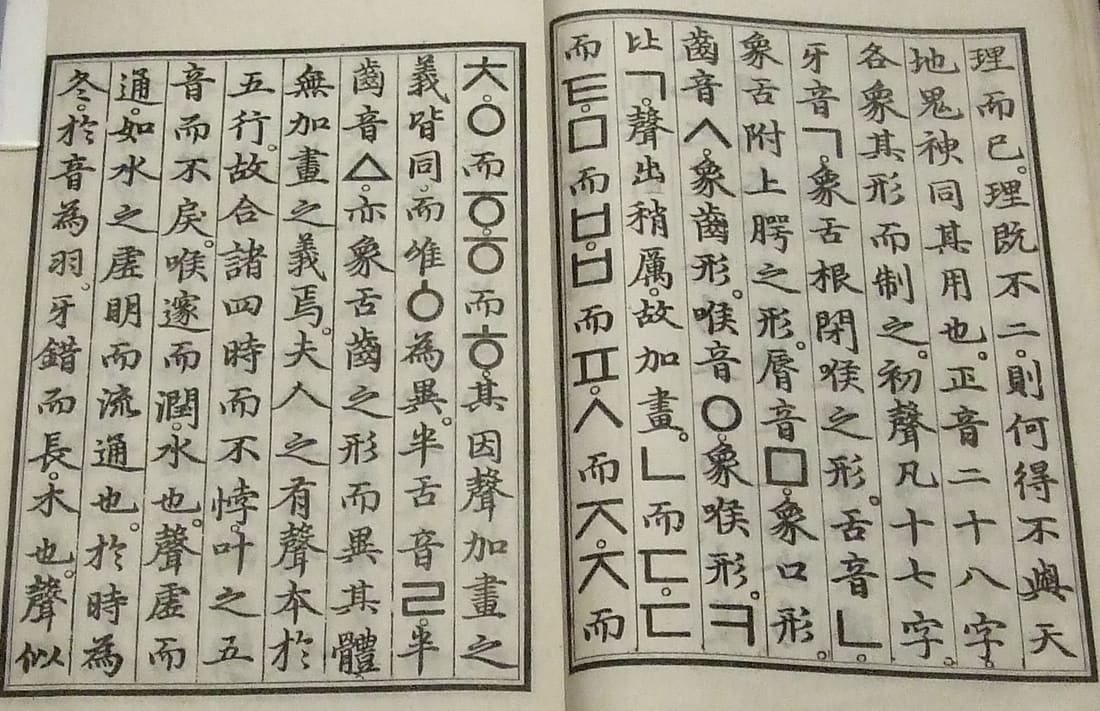
An Alphabet With a Known Inventor
Latin, Cyrillic, the Chinese script — all of them evolved gradually over centuries, shaped by no single person. Hangul isn't like that. It has a king, a year, and a companion document explaining why every letter is shaped the way it is.
Why King Sejong Needed a New Alphabet
Before Hangul, Korea wrote using hanja — Chinese characters, borrowed to write a language they were never designed for. Learning enough hanja to read and write took years of formal education, which meant literacy stayed locked up among the aristocracy. King Sejong, the fourth king of Joseon, wanted an alphabet ordinary people could actually learn — farmers, merchants, anyone shut out of the old system.
He worked on the new script largely himself, revealing it in 1443. It was formally published in 1446 under the name Hunminjeongeum — "the correct sounds for the instruction of the people." The name says the whole project out loud: this alphabet was built for the people who couldn't read yet, not for scholars who already could.
Designed, Not Evolved
The part that gets linguists talking is how deliberate the design is. The consonants aren't arbitrary shapes — each one is a rough sketch of where your tongue, lips, or throat sit when you make that sound. A closed square for the lips-together "m" sound. A line for the tongue tip touching the ridge behind your teeth for "n." Add a stroke for a stronger version of the same sound, and the letter family stays visually related.
The vowels work on a completely different logic: three basic shapes — a dot, a horizontal line, a vertical line — stand for heaven, earth, and person, pulled from Confucian cosmology of the time. Every other vowel is built by combining those three marks.
Sejong's scholars didn't just hand this down — they published a second document, the Hunminjeongeum Haerye, walking through the reasoning letter by letter. That's the part that's genuinely rare: a writing system where the "why" survived alongside the alphabet itself.
From 28 Letters to Today's 24
The original 1446 set had 28 letters — 17 consonants and 11 vowels. A handful fell out of use as spoken Korean shifted over the centuries, which is why the Hangul taught in classrooms today runs a slightly leaner 24: 14 consonants, 10 vowels. Same design logic, just a smaller working set.
What Hangul Day Actually Marks
October 9 marks the anniversary of that 1446 publication — not the invention itself, but the day the finished alphabet was formally released to the country. It's a quiet holiday compared to the big ones: most people just get the day off, and the National Hangeul Museum in Seoul tends to run exhibits and events built around it. It hasn't always had public-holiday status, either — Korea dropped it from the calendar in 1991 and reinstated it in 2012.
Why a 580-Year-Old Alphabet Is Having a Moment Right Now
Sejong's design brief — an alphabet ordinary people could pick up fast, without years of formal study — turned out to be just as useful for a 2026 K-drama fan learning to read subtitles as it was for a 15th-century farmer. Language-learning apps have repeatedly flagged Korean as one of their fastest-growing courses in recent years, and the reason people give isn't Korea's economy or exports — it's the K-pop and K-drama pipeline pulling people toward the language behind it. Hangul's whole selling point, that the shapes tell you how to make the sound instead of asking you to memorize thousands of characters, is exactly what makes it realistic to pick up as a hobby instead of a multi-year commitment.
It shows up in smaller ways too: Hangul's simple, symmetrical letterforms are consistently cited as part of why Korean typing on a phone keyboard feels fast — the same design logic built for handwriting turned out to fit a touchscreen keyboard well, 580 years before touchscreens existed.
Comments open soon.