Jeonju Hanok Village: A Neighborhood Built Twice, a Century Apart
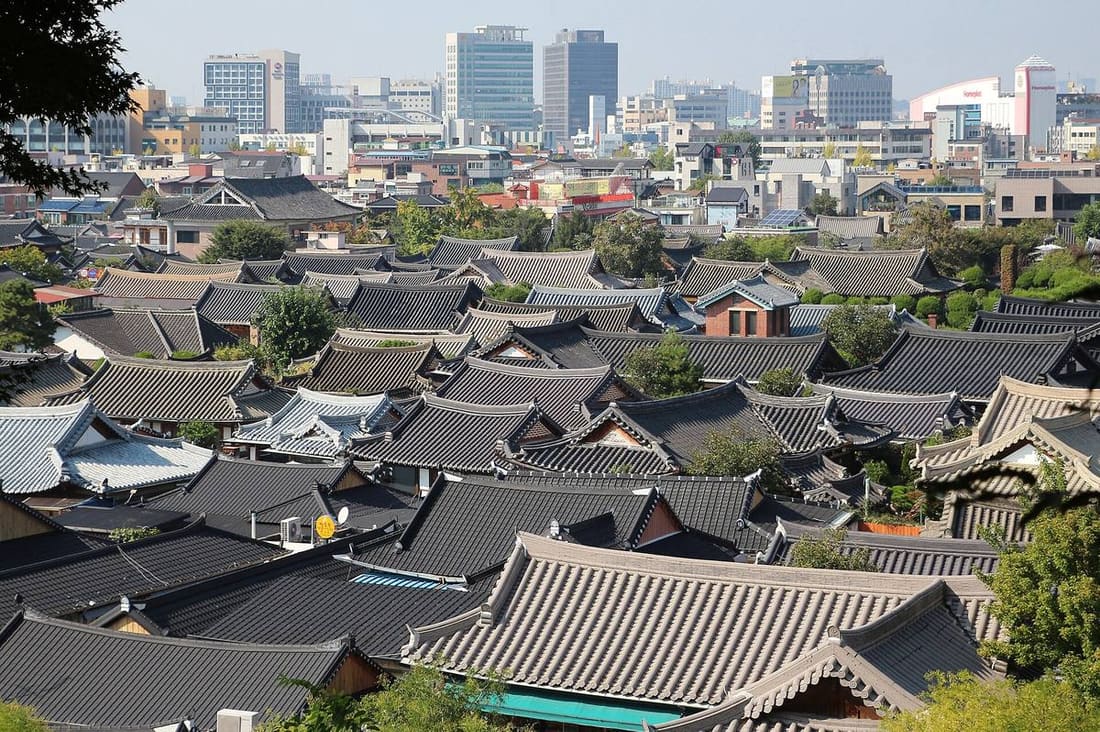
It photographs like the one Korean neighborhood modernization never touched. It wasn't preserved that way by accident — it was built on purpose during Japanese colonial rule, substantially rebuilt again in the 2000s as a tourism product, and its own popularity is now pricing out the people who kept it a real neighborhood.
Not an Old Village — a Deliberate Act of Protest
Jeonju Hanok Village photographs like the one neighborhood Korea's decades of rapid rebuilding somehow skipped over. It didn't get skipped. By the standard account, Korean merchants and gentry built this cluster on purpose, in the middle of Japanese colonial rule, as a direct answer to a Japanese business district expanding next door.
A commercial district that changed hands by 1934
From the 1910s on, Japanese residents concentrated in the blocks just west of Pungnammun, one of the last surviving gates of Jeonju's old fortress wall. Three rounds of Japanese-led urban redistricting, completed by 1934, gridded the city's streets and let those merchants take over Jeonju's largest commercial district — a situation that held until Korea's liberation in 1945.
Building the expensive kind of house, on purpose
Korean landowners and yangban (gentry) responded by settling in around Gyo-dong and Pungnam-dong, the neighborhoods on the gate's other side, and raising a concentrated cluster of giwa-jib — tile-roofed hanok, a materially more expensive build than the area's older, simpler houses. By the 1930s the area had visibly grown into one of the city's more affluent residential pockets. Putting up an entire neighborhood of the costlier, higher-status version of a Korean house was, in effect, a rebuttal aimed directly at the Japanese-style housing spreading through the rest of the city.
A Second Rebuild, on Purpose Again, for Tourists
The neighborhood didn't just sit quietly for the next seventy years. It got substantially rebuilt a second time — this round deliberate, city-planned, and aimed at visitors instead of colonial-era politics.
The preservation rule that had to be lifted to build more hanok
Jeonju's designation as a co-host city for the 2002 Korea–Japan World Cup lined up with the lifting of the area's own hanok preservation-district restrictions, and together the two triggered a redevelopment push under then-mayor Kim Wan-ju: some existing buildings came down, aging hanok were repaired, and new hanok construction was actively encouraged. A chunk of what reads as centuries-old to visitors today was actually built from scratch sometime after 2002 — specifically so that it would.
The village that started Korea's hanbok-rental industry
Jeonju is generally credited as the place that launched Korea's now-nationwide hanbok-rental tourism trend, well before it spread to Seoul's palaces and neighborhoods like Ikseon-dong. The payoff shows up directly in the visitor count: 5.08 million in 2013, 5.92 million in 2014, past 9 million by 2015, a then-record 11.1 million in 2017, and 15.36 million in 2023 — a 36% jump over the year before, with foreign visitors alone nearly quintupling that year, from about 15,400 to over 74,000.
The Bill for Its Own Success
A neighborhood built to assert Korean identity against outside pressure a century ago is now dealing with a very different kind of displacement — its own popularity.
Fewer neighbors, many more storefronts
Between 2009 and 2012 alone, the number of resident households in the hanok village fell from 1,023 to 808, while the number of commercial establishments jumped from 25 to 85, according to research documented in a residents' interview study. Long-standing families and traditional workshops have described being priced out by rents that climbed alongside the tourist traffic — old family homes converting into guesthouses one by one.
Even the "hanok village" isn't all hanok
City figures put the district's current footprint at 947 buildings across 298,260 square meters — and only 735 of them are actually hanok; the other 212 aren't. A 2024 report on the neighborhood described hanbok-rental shops calling out to passersby in many alleys, alongside fortune-telling shops — four of them on a single block, in one case — and visitors describing the experience as noticeably more commercial than they'd expected.
The popular "800-hanok village" figure people usually hear is a rounder, slightly older number — the official count today is a little more precise, and a little more mixed, than that shorthand suggests.
The same shape, twice
It's the same pattern both times. Outside pressure moves in, Koreans respond by deliberately building something that asserts identity, and the response eventually succeeds well enough that the ground shifts again. Japanese merchants prompted the original hanok cluster; a World Cup deadline prompted its reinvention as a tourism product; that product's own popularity is now pricing out some of the people who kept it a lived-in neighborhood rather than a backdrop. None of that makes the hanbok photos less fun to take — it just means the common shorthand that calls this an unbroken, centuries-old village is telling a cleaner story than the real one.
Comments open soon.